

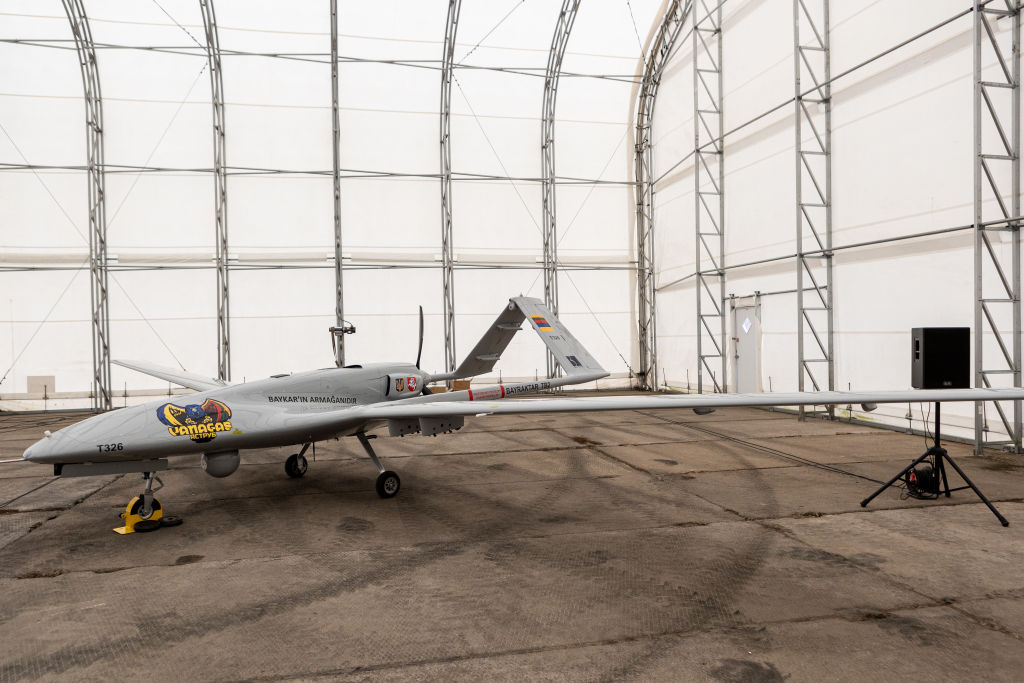
In recent years, Africa’s militaries have gone on a drone-buying binge, stocking their arsenals with unmanned aerial vehicles from Turkey, China and elsewhere. However, new research suggests that those weapons are less effective than expected, especially given the continent’s sprawling spaces, fickle weather and diverse terrain.
A lack of sufficiently trained operators and well-established control infrastructure, such as communications towers, also hinders the usefulness of so-called medium-altitude long-endurance (MALE) drones in many African countries, according to analyst Brendon J. Cannon, a professor at Khalifa University in the United Arab Emirates.
Among the most well-known MALE drone is Turkey’s Bayraktar TB2, which countries including Burkina Faso and Togo have added to their weapons portfolios. It is 6.5 meters long with a 12-meter wingspan. The TB2 and the Akinci, a similar craft that is larger and more powerful, have turned up on battlefields from the Sahel’s Liptako-Gourma region to the Tigray region of Ethiopia and beyond.
“Medium-altitude long-endurance drones can deliver tactical gains but rarely provide a silver bullet,” Cannon wrote in The Conversation.
That’s often because African nations lack the skilled operators, sufficient drone numbers and functional infrastructure needed to support widespread drone operations in the remote areas where extremists operate, he added.
For countries to succeed with drones, Cannon wrote, they need “Sustained investment, not just in drone acquisition but also in maintenance, operator training and basing infrastructure to support continuous flight operations and extend drone reach deeper into battlespaces.”
In many cases, drones face operational obstacles as varied as sandstorms, deep forest cover or clouds that block their onboard cameras and sensors. Overcoming those challenges by flying below clouds or low over treetops exposes the drones to ground fire.
Trained operators are also crucial to successfully deploying drones. In some cases, militaries have used Turkish nationals to operate their Bayraktar drones while training their own operators.
The Sudanese Armed Forces (SAF) used Turkish operators to launch drone attacks against Rapid Support Forces positions in Darfur. The RSF retaliated with its own drone attack against the Port Sudan military base believed to house both the SAF’s TB2s and their Turkish operators.
The 2023 crash of a TB2 operated by Burkina Faso showed how inexperienced operators and maintenance crews can cost their governments millions of dollars. The crash destroyed one of the country’s five TB2 drones.
Poor target choice can also complicate the effectiveness of drones, leading to civilian deaths that transform drones from precision weapons to “harbingers of tragedy,” Cannon wrote.
On top of that, all drones have an operational limit, the point at which they lose contact with operators or must turn around to guarantee enough fuel to return to base. For the Bayraktar TB2, that range is about 300 kilometers, a distance that pales in comparison to the distances that must be covered in places like the Sahel and Ethiopia, Cannon noted.
During the Tigray conflict in 2022, for example, the Ethiopian military had to reposition its drone infrastructure from Addis Ababa to Bahir Dar in the Amhara Region — a distance of 300 kilometers — to operate over Tigray.
Making the most of drones such as the TB2 will require militaries to invest more in training, technology and infrastructure in a way that will overcome the challenges UAVs face on the continent, according to Cannon.
“The initial impression of the TB2 has unfortunately obscured some of its limitations, such as operations across extreme distance, in inclement weather, and the importance of operator proficiency,” Cannon wrote.