
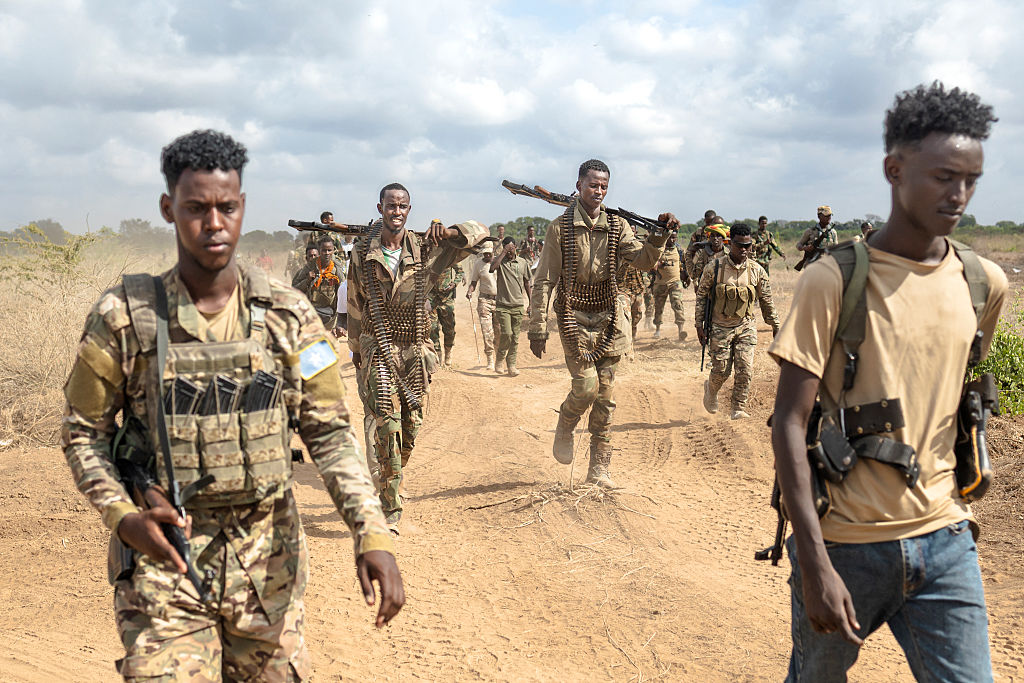
The Somali government wants to expand its armed forces to 100,000 Soldiers to stop the terrorist group al-Shabaab, which controls parts of the Horn of Africa country. One researcher called the current terrorism threat a “deepening crisis.”
Defence Minister Ahmed Maolim Fiqi said his country needs a much larger Army to defend its sovereignty and territorial integrity, the Somali news agency Garowe Online reported on November 9.
Somalia has been fighting the terrorist group for nearly two decades and is getting help from the African Union Stabilization Support Mission in Somalia. The peacekeeping operation started this year, replacing the African Union Transition Mission in Somalia. The current mission’s goals are to stabilize the country, help fight al-Shabaab and eventually hand over all security responsibilities to the Somali government.
Fiqi said that although the AU mission remains important, the country needs to build its own independent defense system.
“Real security will only come when Somali soldiers, not foreign ones, are responsible for protecting our people and borders,” the minister said.
Al-Shabaab, one of al-Qaida’s strongest affiliates, exploits Somalia’s governmental capacity and its humanitarian crises, launching “indiscriminate attacks against government forces, foreign peacekeepers, and civilians,” according to the Center for Preventative Action. Like other terrorist groups operating in Africa, al-Shabaab’s goal is to destroy the federal government and establish a rigid interpretation of Shariah.
The terrorist group reached its peak in Somalia in 2011, when it controlled parts of the capital, Mogadishu, and the port of Kismayo. Working with AU peacekeepers, Somali forces pushed al-Shabaab out of the capital and other areas.
To revitalize its insurgency, al-Shabaab announced its allegiance to al-Qaida in February 2012 and regrouped, launching a series of attacks across East Africa. The group has increased its attacks in Somalia in the years since, aided by the faltering support of internationally backed counteroffensives and the weakening capacity of the Somali government, the Center reported.
TROOP ESTIMATES VARY
The Somali Armed Forces currently has an estimated 30,000 to 40,000 troops.
The Military Power Rankings index says that Somalia also has 10,000 paramilitary forces, which include special police units and clan-based militias.
Journalists and researchers say the al-Shabaab threat against Somalia is particularly intense. In a November 2025 report for the Africa Center for Strategic Studies, researcher Matt Bryden said Somalia faces a “deepening crisis involving an ascendant jihadist insurgency, a faltering peace support operation, domestic political polarization, and regional geopolitical competition.”
The Somali government, Bryden said, controls only Mogadishu and a few nearby towns. He wrote that without a dramatic change in direction, Somalia’s federal government faces collapse and an al-Shabaab takeover of the capital.
“Pulling Somalia back from the abyss and on course to recovery may still be possible, but it is primarily a political challenge rather than a military one,” Bryden wrote. “Al Shabaab can only be defeated through simultaneous military action on multiple fronts, with the strategic objective of dismantling their strongholds in the Juba River Valley and southwest Somalia.”
Researchers also note that the Somali Armed Forces (SAF) has learned from its experiences in fighting terrorism.
“Somalia’s military is in the midst of a long-term reconstruction process, gradually transforming from a fragmented security network into a functioning national defense force,” Military Power Rankings said in a 2025 report. “While far from conventional parity with regional powers, the SAF is becoming increasingly active in counterinsurgency, urban stabilization, and territorial recovery.”
Military Power Rankings said that while Somalia’s armed forces are understaffed, the country is making genuine progress:
“Its current ranking reflects both its limited conventional capability and its ongoing evolution, recognizing that Somalia’s defense forces, while under-resourced, are engaged in real-time combat with growing institutional momentum.”