

With his hands in bandages and his voice shaking, the Kenyan man wore a mask to hide his identity because he lives in fear of retribution from Russian authorities. Speaking publicly for the first time, he described the “living hell” he experienced after being lured to Russia under false pretenses and forced to fight in the war against Ukraine.
“I thought I was signing a basketball contract,” he told the BBC in a February podcast. “I was tricked, and I don’t want any Kenyans or Africans to be tricked in the same way I was.”
Shot in both hands and in the leg, he said the wounds he has today are less of a concern than the psychological scars of watching men killed by Russians for refusing to fight or killed by drone strikes.
“It really affected me,” he said. “Because I’m not OK psychologically. I don’t like loud sounds. During the night I have no sleep.”
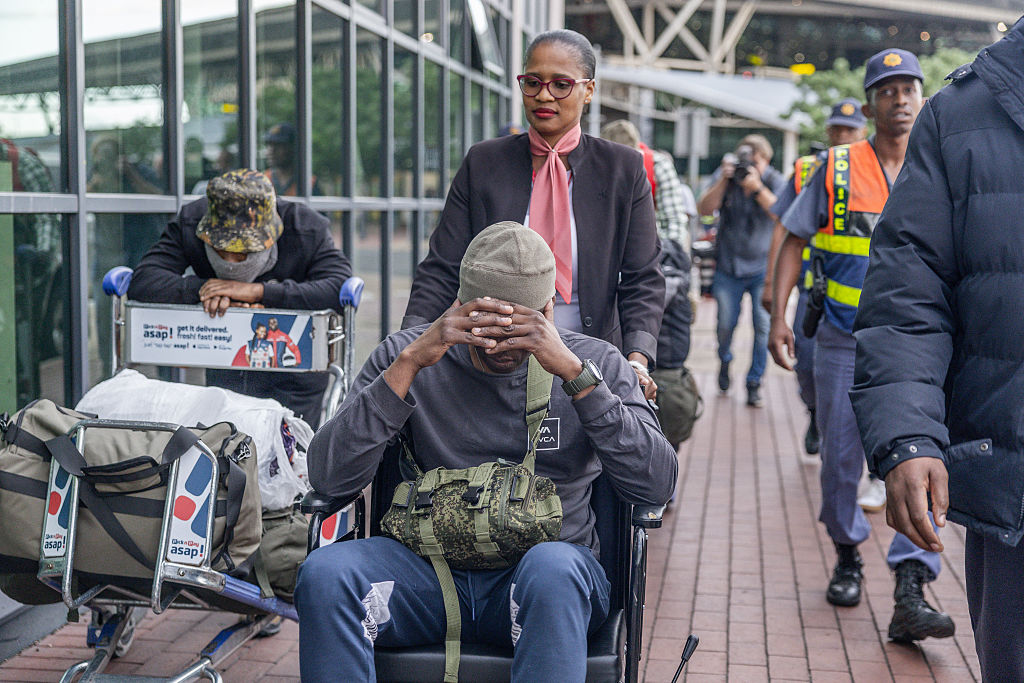
Experts have estimated that thousands of Africans have been recruited into Russia’s war, many of them tricked and coerced into nightmarish combat. Emotional trauma is one of many hidden costs that survivors are bringing back to their homes in Africa. In a high-profile case, 15 South African men were lured to Russia with false promises of security training, only to end up on the front lines in Ukraine. Some of the men returned with their heads hung in shame. One covered his face as he was taken from an airport in a wheelchair.
Without having met them, Dr. Keitumetse Mashego, a clinical psychologist based in Pretoria, South Africa, advised the men and their families to seek help.
“They will need intervention definitely,” she told Newzroom Afrika in a March 8 broadcast. “The intense emotions, they will vary from guilt, embarrassment, anxiety, depression.
“There’s a lot of anger that you’re carrying or betrayal or a sense of shame. If you’re not dealing with it, you will project it somewhere or another. Unfortunately, there’s still so much stigma. They would really need to be intentionally encouraged to seek help so that they can process what has happened and be able to move on. The sad thing about psychological issues and trauma is that as a victim, even if it’s not your fault, it’s really unfair because the onus is on you to take responsibility.”
James W. Njogu, a legal advocate of the High Court of Uganda, recently alerted Africans to another hidden danger that survivors are bringing home.
“History offers a troubling warning,” he wrote in a February opinion piece for Ugandan newspaper The Daily Monitor. “Africans recruited to fight in the First and Second World Wars returned home with combat skills and political awareness that later shaped liberation movements in the 1950s and 1960s. While those struggles helped dismantle colonial rule, they also contributed to prolonged armed conflicts, coups and militarization in the post-independence era.”
Survivors of Russian recruitment and warfare carry similar risks, he said.
“African recruits in Ukraine are being exposed to advanced weapons, drone technology, coordinated battlefield tactics and psychological conditioning unlike anything previously seen,” he wrote. “When these fighters return, often traumatized, unemployed and unsupported, the danger does not disappear at the airport.
“In fragile or politically tense states, such returnees could be drawn into criminal gangs, private militias, extremist groups or rebel movements. The combination of military expertise and economic desperation is a volatile mix. Africa has already witnessed how small groups of trained fighters can destabilize entire regions.”