

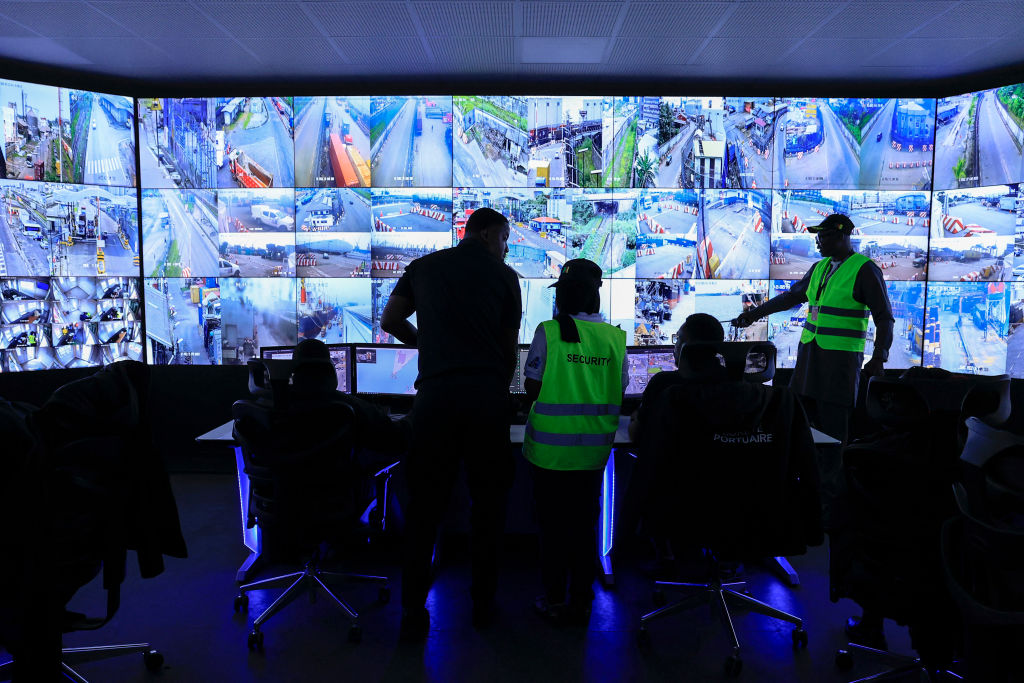
A shadowy industry is thriving alongside Africa’s digital boom: mass-surveillance systems powered by artificial intelligence. As Chinese-built surveillance technology is proliferating across the continent, experts are warning that it is a dangerous threat to citizens’ rights.
“You have highly sophisticated, high-definition, internet-based cameras that are filming 24-7, you can enable it with facial recognition,” independent researcher and journalist Heidi Swart told ADF. “If you combine that with a population register database, it allows you to actually track people as they go about their business. If you store up the data collected by all these cameras, it can give you an accurate map of a person’s movements over time.
“It’s highly, highly invasive, and there seems to be sort of an acceptance by the public.”
Eleven African governments have spent at least $2 billion on Chinese-made surveillance technology, according to a March 12 report by the Institute of Development Studies on “smart city” surveillance in Africa.
Chinese companies frequently sell the technology to governments in packages that include closed-circuit television systems with cameras that have AI-enabled facial recognition and can track vehicle movements. Experts say these tools are presented alongside a myth that they help reduce crime and modernize urban areas.
Researchers Wairagala Wakabi and Tony Roberts, who co-authored the report, said there is no evidence that “smart city” systems reduce crime. Instead, they warned, the rapid expansion of surveillance technology has allowed governments to monitor political opponents, journalists and activists.
“This large-scale and invasive AI-enabled surveillance of public spaces is not ‘legal, necessary or proportionate’ to the legitimate aim of providing security,” Wakabi told British newspaper The Guardian for a March 12 article. “History shows us that this is the latest tool used by governments to invade the privacy of citizens and stifle freedom of movement and expression.”
Nigeria topped the report’s list of digital infrastructure purchases in 2025, spending $470 million on 10,000 smart cameras that recognize faces and vehicle license plates. Egypt has 6,000, while Algeria and Uganda each have installed about 5,000. The 11 countries spent an average of $240 million with the investments typically funded by loans from Chinese banks.
A spectrum of rights groups, civil society groups and journalism organizations have warned that widespread use of surveillance technology can put citizens under a microscope and threaten privacy, freedom of speech and assembly.
“Facial recognition systems, predictive analytics and other AI surveillance tools are being adopted by governments across the region, ostensibly for security purposes, but with profound implications for press freedom,” Penplusbytes, a Ghana-based government accountability organization, wrote in a January article. “These technologies are able to track journalists’ movements, monitor their online activities, and identify their sources, creating a chilling effect on investigative reporting. In countries with weak data-protection frameworks, such surveillance occurs with minimal oversight or accountability.”
Admire Mare from the University of Johannesburg said that authoritarian governments across the continent have become adept at turning digital infrastructure against their own citizens through internet shutdowns, state-sponsored disinformation campaigns and mass surveillance. He continues to raise alarms and rally support for independent oversight and accountability for these systems that administer much of public life.
“For far too long, platforms, algorithms and AI systems have been mythologized as ‘black boxes’,” he said in a March 23 lecture. “We need to insist that the black box of technology should be opened.”
Living in a major metropolitan area in South Africa, Swart has seen cameras installed throughout urban areas and is concerned that the public has a sense of resignation.
“People seem to just be going along with it, or even welcoming it,” she said. “I think it’s naive and I think it’s also irresponsible. If you pay attention to authoritarian regimes, you will know that these type of surveillance systems are central to propping up their power. It really is the architecture of an oppressive regime.
“People don’t seem to realize that. They don’t seem to consider that this stuff can go horribly wrong. It can, in a heartbeat, be misused by a seemingly democratic government to persecute people.”