

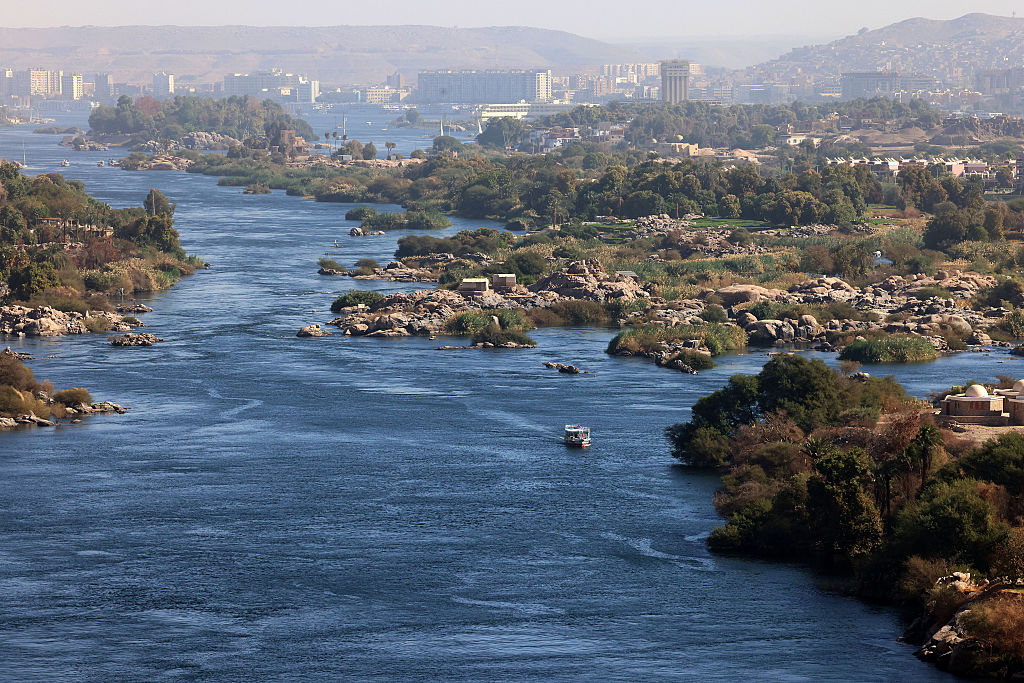
A dispute over freshwater access is brewing in southern Africa. Zimbabwe is building Gwayi-Shangani Lake, a reservoir to guarantee a water supply for its second-largest city, Bulawayo, and to irrigate a 10,000-hectare greenbelt along the dam and the city.
The water will be drawn from the Zambezi River. The lake also will stop the Gwayi River from discharging into the Zambezi, which forms the border between Zambia and Zimbabwe.
For this reason, Zambia, which has about 42% of the Zambezi River basin, always has opposed Zimbabwe’s plans to divert river water. So strong is its opposition that since the 2004 formation of the Zambezi Watercourse Commission, Zambian officials have refused to sign the commission’s agreement.
Disagreements like this are repeated to varying degrees across Africa’s 63 major river basins as countries jostle to secure future water and energy supplies, turning water security into a geopolitical flashpoint. Changing weather patterns, characterized by frequent and longer droughts, shorter rainy seasons and higher temperatures, make water increasingly scarce, increasing the potential for conflict.
Experts warn that by 2100, Africa’s arid and semiarid regions could increase by 5% to 8%. Projections indicate that Central Africa will become wetter while Southern Africa continues to dry. The Zambezi River is expected to lose up to 40% of its water by 2050.
A 2022 report by the United Nations University Institute for Water, Environment and Health said that only 13 of Africa’s 54 countries have attained some level of water security. According to a 2025 Pacific Institute report, water-related conflicts are increasing in Sub-Saharan Africa, with 76 recorded in 2024, up from 56 in 2023 and 44 in 2022. Experts predict that these conflicts could reach 1,000 annually by 2050 if access is poorly managed.
Institute statistics indicate a number of factors that contribute to conflicts. Farmers and herders clash over water, often violently. Terrorists target water infrastructure and access.
Perhaps Africa’s most high-profile water dispute centers on the Grand Ethiopian Renaissance Dam, which Ethiopia inaugurated in 2025. It’s the largest hydropower project on the continent, built on the Blue Nile tributary about 14 kilometers from Sudan’s border.
Egypt, which relies on Nile waters for agricultural and domestic uses, has said the dam could threaten its water security. Sudan has expressed concern about safety and sedimentation.
The three countries have negotiated off and on since 2011, but no binding agreement has been reached. “Ethiopia continues to assert its right to develop hydropower resources within its territory, while Egypt maintains that any upstream development must protect downstream water security,” according to the website International Water Power and Dam Construction.
Zambia and Zimbabwe are opposing plans by Botswana and Namibia, each with only 1% of the Zambezi Basin, to divert Zambezi waters where the four countries’ borders meet.
South Africa wants to join this project, which seeks to divert water southward, to augment its supplies. This diversion would affect Victoria Falls, a global tourist draw for Zambia and Zimbabwe, and shared power generation at Lake Kariba and downstream at Cahora Bassa in Mozambique.
Although Zambia opposes these upstream water withdrawals on the Zambezi, it is trying to do the same thing in the north. The country straddles the Congo-Zaire river basin in the north and the Zambezi basin in the south. After the devastating drought of 2023-24, Zambia resolved that an interbasin water transfer was the only way to secure water and power supplies.
It engaged a Chinese company to dig a 300-kilometer trench to divert Luapula River water to the Kafue River, on which two of its hydropower plants are located. The Luapula River is a tributary of the Chambeshi River, the Congo River’s source.
Zimbabwe wants to draw 16 billion cubic meters of water from the Lualaba River in the Democratic Republic of the Congo using a 1,200-kilometer tunnel through Zambia to Lake Kariba. This would require agreement from Congo and Zambezi river basin members.
Namibia and Botswana also are at odds over Namibia’s plans to withdraw from the Okavango River, which would decrease water flowing into the Okavango Delta, Botswana’s premier tourist attraction.
Professor Desmond Manatsa, chairperson of the African Alliance of Disaster Research Institutes, said there is a critical nexus between water access and continental security.
“Water is the lifeblood of African economies, particularly given our heavy reliance on rain-fed agriculture,” said Manatsa, executive dean of the Faculty of Science and Engineering at Bindura University of Science in Zimbabwe.
“When weather patterns shift, the resulting water scarcity creates a zero-sum competition for dwindling resources,” Manatsa said. This manifests in two primary ways, he said. The first is through localized resource tensions. The second is in transboundary risks.
Dr. Nidhi Nagabhatla, senior research fellow at United Nations University’s Institute on Comparative Regional Integration Studies, said that her research in Africa had established links among weather, water and security.
“Changing weather patterns can certainly contribute to serious water stress in parts of Africa, and in some contexts, this can become a factor in future conflicts or, more often, in heightened tensions, localized violence and broader insecurity,” she said.
Some studies suggest a potential increase of more than 50% in armed conflict risk in Sub-Saharan Africa by 2030 linked to weather-related resource scarcity. Manatsa says the future depends heavily on water governance.
“In regions with weak institutional frameworks, water scarcity is far more likely to lead to violence.”
ABOUT THE AUTHOR
Cyril Zenda is a journalist based in Harare, Zimbabwe. His work has appeared in Fair Planet, TRT World Magazine, The New Internationalist, Toward Freedom and SciDev.Net.