
With geopolitical fault lines deepening in the Sudanese civil war, experts are warning that there is a growing threat of regional war spilling into the neighboring tinderbox that is the Horn of Africa.
Gulf State rivals Saudi Arabia and the United Arab Emirates have taken opposing sides in the Sudan war and have become increasingly polarized in the Horn.
“Competition involving the Gulf states and Turkey in the Horn of Africa is exacerbating preexisting African conflicts and risking a regional proxy war on both sides of the Red Sea,” researchers Liam Karr and Michael DeAngelo wrote in a February 24 analysis for the Critical Threats Project.
The Sudanese Armed Forces (SAF) claim that the UAE has provided crucial military support for the rival paramilitary Rapid Support Forces (RSF), which has drawn international sanctions for its genocidal acts against non-Arab Sudanese. The UAE has officially denied taking a side in the Sudanese war.
The Emirates also have become an important ally to Ethiopia, which seeks controlling access of a Red Sea port and has threatened to seize one by force if necessary.
The Saudis have partnered with Egypt in supporting the SAF’s cause, while deepening ties with Djibouti; Ethiopia’s archrival, Eritrea; and Somalia. Egypt has what it considers an “existential” dispute over the Nile River with Ethiopia, which inaugurated the Grand Ethiopian Renaissance Dam in late 2025.
At any time, several of the Horn’s long-running disputes could spark armed conflict. The most pressing issues concern Ethiopia. Ethiopian Minister of Foreign Affairs Gedion Timothewos in February wrote an open letter accusing Eritrea of keeping troops on the Ethiopian side of the border and calling for them to leave.
“The incursion of Eritrean troops …” he wrote, “is not just provocations but acts of outright aggression.”
Denying the claim, Eritrean Minister of Information Yemane Gebremeskel described repeated accusations as “an agenda of war against Eritrea.”
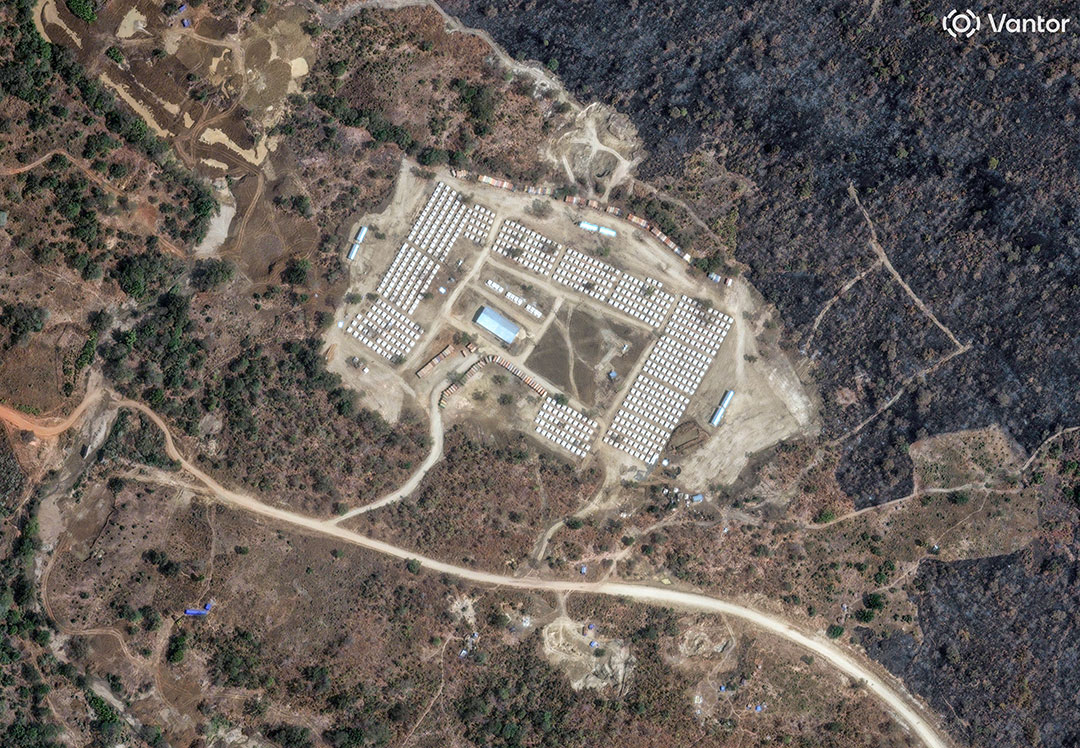
Another bombshell report dropped on February 10, when Reuters reported that Ethiopia is hosting a secret camp to train thousands of RSF fighters. The news service cited eight sources, including a senior Ethiopian government official, who claimed that the UAE financed the camp’s construction and provided military trainers and logistical support to the site.
The UAE foreign ministry repeated its denial that it is not “in any way” involved in Sudan’s conflict. Spokespersons for Ethiopia’s government, its Army and the RSF did not respond to Reuters’ requests for comment.
Since late 2025, tensions have tipped closer to a boiling point between Ethiopia, supported by the UAE; and Egypt, supported by Saudi Arabia; Karr and DeAngelo said.
“The UAE is setting conditions to escalate proxy competition in the Horn of Africa,” they wrote. “Several African actors in Ethiopia, Somalia and Sudan could choose to escalate and drag their middle-power sponsors with them. The nearly three-year-long Sudanese civil war and more recent infighting between Emirati and Saudi proxies in Yemen in December foreshadow the proxy competition set to break out across the region.”
In a recent speech at a military parade in the city of Hawassa, Prime Minister Abiy Ahmed declared that Ethiopia now has the capacity to “eliminate threats from the tip of Moyale to the tip of Massawa,” a Red Sea port city in Eritrea.
Geopolitical analyst Mohamed Marshal said that Abiy’s projecting of military strength in the context of port access is just one of many interconnected parts of a broader geopolitical recalibration of the Red Sea region.
“The Horn is no longer peripheral,” he told The Africa Report news website for a February 24 article. “It is tied to Gulf rivalries, Sudan’s war, Nile politics and global shipping routes. Ethiopia’s sea access discourse is part of that structural shift.”
Karr and analyst Cameron Hudson warned that one spark in Ethiopia could set off a disastrous war on both sides of the Red Sea.
“The Red Sea region has already become one of the most hotly contested areas on Earth in recent months and years,” they wrote in a January 27 article for Foreign Policy magazine. “If Ethiopia emerges as a new front in Sudan’s civil war, this would exacerbate the world’s largest humanitarian and refugee crisis. It would also threaten international commerce and would create opportunities for a host of malign actors, ranging from Russia and Iran to al-Qaida, the Islamic State and the Houthis.”