
A global study has concluded that Burkina Faso in West Africa is now the country most affected in the world by terrorism, even more than Mali, its troubled neighbor to the north.
The latest Global Terrorism Index says that one-fourth of all extremist attacks worldwide, and nine of the world’s 20 deadliest attacks, came in Burkina Faso in 2024.
Three such attacks came in late January and early February 2026, as terrorists with Jama’at Nusrat al-Islam wal- (JNIM) killed at least 38 civilians, abducted nine women and burned property, Human Rights Watch said. The terrorists attacked Sollé village and Tiao city in the North region and a gendarmerie post in Manni town, East region.
“JNIM brutality against civilians in Burkina Faso has been unrelenting,” said Ilaria Allegrozzi, senior Sahel researcher at Human Rights Watch.
For years, terrorists have roamed the rural areas of the country of 23 million, attacking military posts, ambushing convoys and destroying the lives of civilians. The landlocked country is bordered by Benin, Côte d’Ivoire, Ghana, Mali, Niger and Togo.
Diplomats and humanitarian officials estimate that the total number of people displaced in Burkina Faso could be between 3 and 5 million, with regular reports of Burkinabe refugees fleeing to Côte d’Ivoire, Ghana and Senegal. About 6 million people in the country needed humanitarian assistance in 2025, according to the Humanitarian Response Plan.
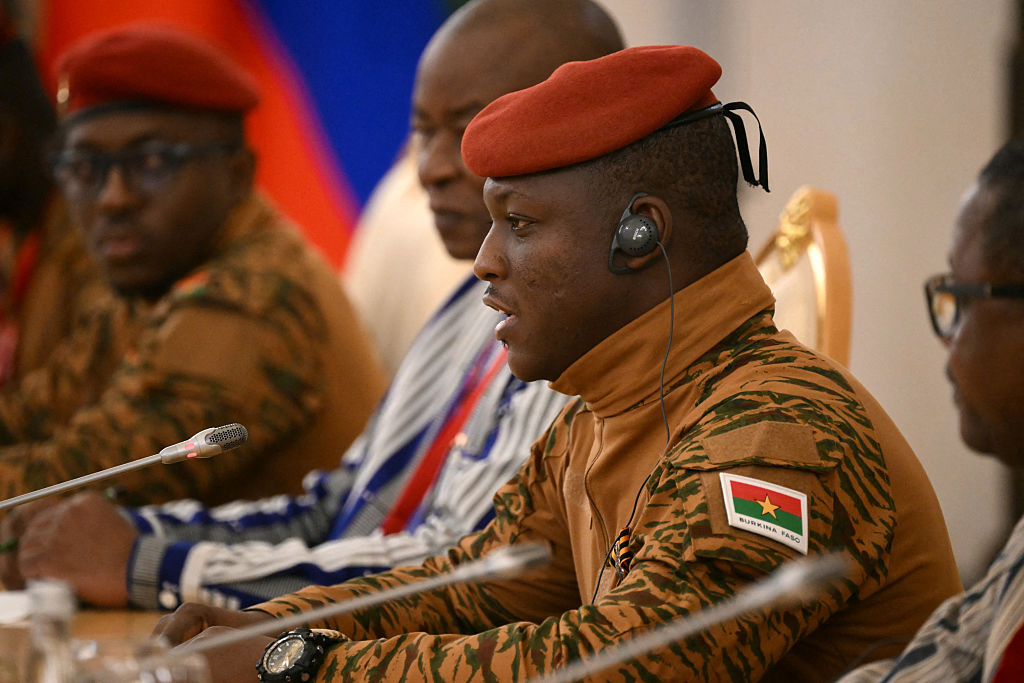
Security conditions have worsened significantly in Burkina Faso since military officer Ibrahim Traoré took control of the government in a 2022 coup. Since then, the Atlantic Council reports, terrorists have killed an estimated 87% more civilians than in the preceding three years.
Terrorists have killed about 2,000 civilians in the country annually in recent years, according to some estimates. Government-aligned forces are reported to have killed up to 132% more civilians in that time, the council reported. Terrorists linked to al-Qaida and the Islamic State group now operate openly in as much as 80% of the country.
A wave of civilian support enabled Traoré to take power with promises of bringing terrorists in the country under control. Crowds rallied in support of the coup, praising the young officer and demanding aggressive military action against the terrorists where previous leaders had failed. Supporters portrayed Traoré, now 38, as a revolutionary leader who would end the brutality that had spread throughout the country since 2015.
That did not happen. Under Traoré, Burkina Faso has now become the epicenter of terrorism in the Sahel. To stay in power and stifle political opposition, he has taken control of the media and suppressed information about the state of his country’s security.
“A combination of domestic repression and online veneration has insulated his regime from scrutiny, even as battlefield losses mount and civilian casualties rise,” the Atlantic Council reported.
Traoré and his two brothers control security information with support from Russian advisors, according to the Africa Center for Strategic Studies.
“With the aid of a cadre of online influencers, intelligence-linked operatives, and affiliated media pages, the Traoré junta has extolled his reported achievements as a transformative leader paralleling the iconic Thomas Sankara,” the Africa Center said, referring to Burkina Faso’s revolutionary leader of the 1980s.
Government officials have restricted independent media outlets and international news organizations such as Radio France International and France 24. Some news outlets have been suspended after publishing or broadcasting reports that the government said were inaccurate or damaging to national morale, according to Al Jazeera and other news agencies.
In April 2024, Traoré temporarily suspended the BBC and Voice of America after both organizations reported on human rights abuses allegedly committed by security forces, the Atlantic Council reported. He also stripped four foreign nongovernmental organizations of their licenses, citing national security concerns.
The country is one of three landlocked West African countries, along with Mali and Niger, run by juntas that have formed their own bloc, the Alliance of Sahel States, after breaking from the Economic Community of West African States. All three countries have postponed elections indefinitely.
In late January, the Burkina Faso junta dissolved all political parties in the country and gutted laws that would limit its power. The decree requires the assets of the parties to be transferred to the state, the government-run news agency said. Government officials said the political parties had “deviated from the guidelines establishing them,” The Associated Press reported.
“Burkina Faso is experiencing a fatal cycle of anti-Western sentiment, authoritarian revanchism, and militant sectarianism,” researcher Raphael Parens wrote for the Foreign Policy Research Institute. “While Traoré clings to power in Ouagadougou, making full use of disinformation techniques supported by Russia and China, the country is sliding toward failed statehood — if it isn’t there already.”