

Somalia’s al-Shabaab terrorists and Yemen’s Houthi militants have long been known to cooperate across the Red Sea, capitalizing on entrenched networks that enable all kinds of illicit commerce back and forth from East Africa to the Arabian Peninsula.
Now, however, evidence indicates that links forged more than a decade ago might be taking on a more tangible, and dangerous, character.
“The cooperation is now advancing beyond fundamental logistical and intelligence coordination into political, media and direct military collaboration,” according to a 39-page February 2026 report by Somalia’s Mogadishu-based Saldhig Institute research organization.
“We were aware that the relationship was very much on basic lines, where they were just cooperating on a kind of needs-based cooperation, but not in a connection that we can call a proper relation,” report author Hussein Sheikh-Ali told The Africa Report magazine for a February 17 report. “It was mainly the weapons trafficking.”
“In this particular relationship that we’re now addressing in this paper, it is a bit more alarming, it is more systematic, more strategic and it has every sign that it should be a huge concern for anyone concerned about regional security,” the former Somali national security advisor said.
Al-Shabaab is the more notorious and well-known of the two groups. It gained prominence in 2006 and eventually aligned itself with al-Qaida. The Houthis’ roots are planted in the 1990s, when they emerged under the name Ansar Allah, which means “Partisans of God.” Their more common name is taken from their late founder. They represent the Zaidis, a sect of Yemen’s Shia Muslim minority. Al-Shabaab is a Sunni Muslim group.
Observers have been tracking cooperation between the two groups for several years. The alliance “began as an exchange of information and maritime facilitation and subsequently evolved into logistical and technological collaboration,” the report states.
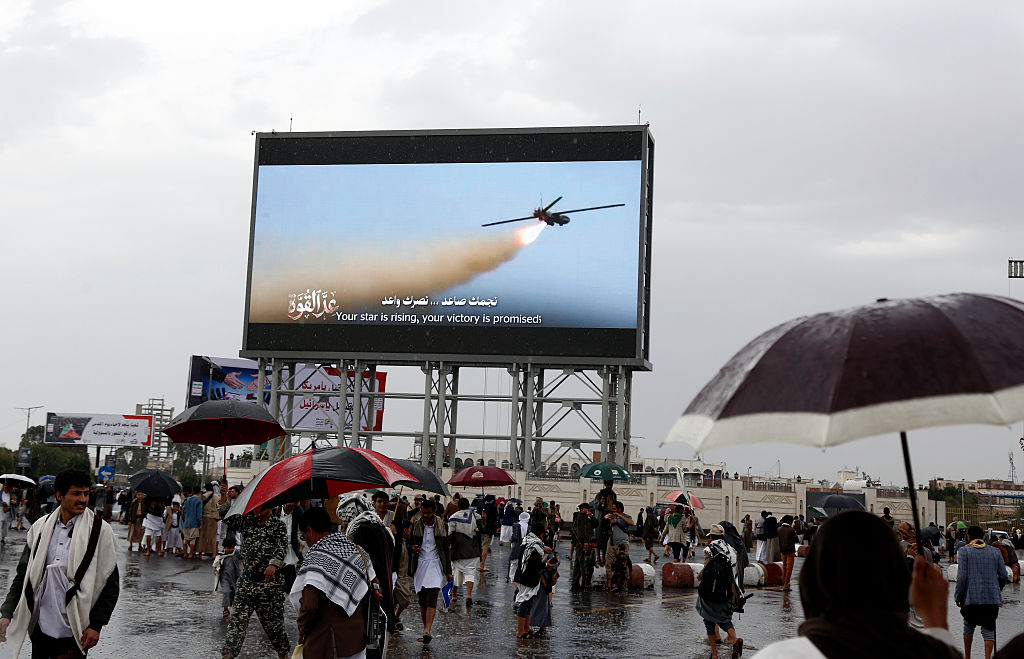
Confidential sources told the United Nations Panel of Experts on Yemen that the Houthis were training al-Shabaab members in drone technology and how to manufacture sophisticated improvised explosive devices (IEDs). Al-Shabaab already had been using drones for surveillance, but the Houthis could show the Somali terrorists how to use the technology for attacks, the October 2025 U.N. report states.
“The procurement of weapons and related materiel is a key driver of al-Shabaab’s operations,” the institute report says. The Houthis make Yemen an attractive place from which al-Shabaab can source advanced weaponry such as longer-range missiles used in naval operations, explosive materials, IEDs, and short- and long-range drones.
“If Al-Shabaab were to obtain even minor quantities of this technology, its ability to sustain resistance against the Somali government and international peacekeeping forces under [the African Union] would be significantly augmented,” the institute reported.
Sheikh-Ali warned that military-grade drones or missile systems would be a “gamechanger” in Somalia if the Houthis chose to supply them to al-Shabaab or helped the Somali terrorists build their own.
Al-Shabaab has used commercial rotary wing and fixed-wing drones since at least 2018, according to a 2024 United Nations Institute for Disarmament Research report by associate researcher Bárbara Morais Figueiredo.
Primary uses have included intelligence, surveillance and reconnaissance; and for spreading propaganda in Somalia and Kenya, she wrote. In 2021, the terrorists increased drone use for reconnaissance and to monitor security forces. Although al-Shabaab hadn’t yet used drones for strikes, “its use of these systems has reportedly facilitated high-profile attacks carried out by the group against Somali, Kenyan and foreign military personnel.”
“All evidence suggests that the relationship between Al-Shabaab and the Houthis is gradually evolving towards more strategic collaboration,” according to the Saldhig Institute report. “Al-Shabaab views cooperation as important for its survival and expansion, for acquiring weaponry, and for sustaining its existence, whilst the Houthis want to avoid sanctions and maintain their regional supremacy.”