

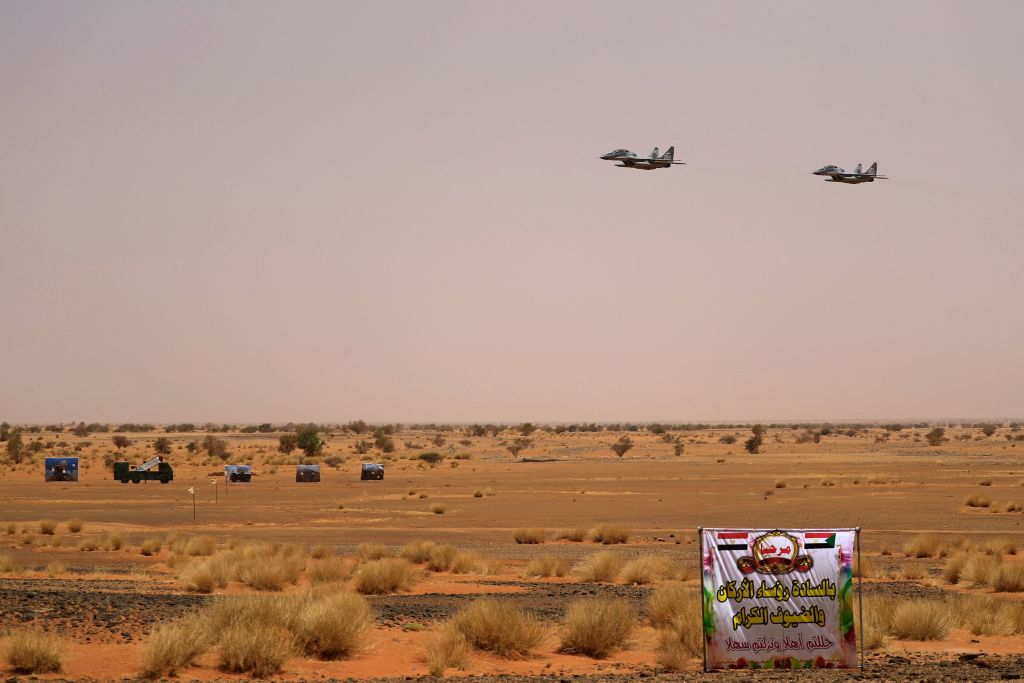
As Sudan’s civil war rages to its south, Egypt has boosted security along its southwestern border to prevent violence and terrorism from spreading into its own territory.
In recent months, the Egyptian military added Turkish-made Bayraktar Akinci drones to a military base near Sudan and reportedly carried out airstrikes against the paramilitary Rapid Support Forces (RSF) that have been fighting the Sudanese Armed Forces (SAF) for control of the country since April 2023.
Analyst Jalel Harchaoui in December claimed on X that Egyptian fighter jets had carried out “destructive airstrikes” in the al-Kufra region of Libya against RSF supply convoys moving into Sudan. Those strikes came after similar Egyptian strikes against RSF positions in northwestern Sudan in June 2025.
RSF fighters took control of the Egypt-Libya-Sudan triangle in mid-2025, securing a route for weapons and other materiel to move from a closed airbase in the al-Kufra region controlled by RSF supporter Libyan Field Marshal Khalif Haftar.
“The deliveries reportedly include ammunition, light arms, and possibly spare parts for armored equipment, critical for an army rapidly depleting its resources in ongoing battles,” The Sudan Times reported in November 2025. “This flow of weapons not only strengthens one side over another but perpetuates the war by providing external support instead of allowing political solutions to take effect.”
The attacks on RSF convoys marked an escalation of Egypt’s involvement in the Sudanese conflict. Until recently, the Egyptian government has supported Sudan’s internationally recognized government led by SAF Gen. Abdel Fattah al-Burhan with logistical and technical support, but otherwise remained on the sidelines.
Egyptian authorities stated in December 2025 that their national security was directly tied to Sudan’s. They laid out red lines that they said should not be crossed by the Sudanese conflict. Among those red lines is preserving Sudan’s territorial integrity and rejecting the RSF’s attempt to create a parallel government that could threaten that integrity.
That integrity has been threatened by the RSF’s conquest of Darfur, which it accomplished with the fall of el-Fasher, the capital of North Darfur, in October 2025. North Darfur had been the final government bastion in western Sudan. In January, representatives of Doctors Without Borders visited el-Fasher and reported that the city was empty and “largely destroyed.”
RSF leader Gen. Mohamed Hamdan “Hemedti” Dagalo declared a parallel government in RSF-held territory in July 2025. At the time, his forces controlled the majority of the Darfur region along with much of southern Sudan. By helping Hemedti consolidate power in western Sudan, the fall of el-Fasher shifted Egypt’s stance on Sudan’s conflict.
“The partition of Sudan is a red line Egypt will not allow anyone to cross,” said Egyptian Foreign Minister Badr Abdelatty in November 2025.
Since the Sudanese conflict broke out, Egypt has received more than 1.2 million Sudanese citizens who have fled to escape violence. Some of those people began returning to Sudan after the SAF retook control of the Khartoum region last year.
Analysts have worried that the Sudanese conflict could evolve into a broader regional fight with Egypt, Qatar, Saudi Arabia and Türkiye supporting al-Burhan’s government, while Libya’s Haftar and the United Arab Emirates support the RSF.
United Nations experts have identified the UAE as the source of weapons to the RSF. The UAE denies supporting the RSF.
Egyptian authorities believe that RSF control over western Sudan could allow Sahel terrorist groups to spread into southwestern Egypt.
“Unrelenting fighting inside Sudan is in itself a threat to Egypt’s national security,” Egyptian political researcher Ahmed Abdel Meguid told The New Arab.
Egypt aims to deter that threat by continuing to call for a peaceful resolution to Sudan’s nearly 3-year-old conflict in a way that keeps Sudan intact.
According to The Sudan Tribune: “Egypt’s real interest lies in ending the war, not prolonging it. Sudanese stability is a strategic necessity for Cairo, forming a key southern buffer. Instability there risks regional chaos and unpredictable security threats.”