
A new report documents the huge scale of illegal activity by Chinese “floating fish factories” that set up off the coast of Guinea-Bissau and harvest marine resources by the ton.
The Hua Xin 17, listed as a 125-meter Chinese cargo ship in maritime databases, was anchored for 157 days in 2025 about 50 kilometers off the coast of Orango Island, part of Guinea-Bissau’s protected Bijagós archipelago. The Tian Yi He 6, also listed as a cargo vessel, spent 244 days about 60 kilometers from the island last year.
An investigation by The Guardian and DeSmog, an investigative journalism organization, showed that the vessels actually are factories that process fresh sardinella into fishmeal and oil by the ton. A group of six Turkish boats that supply the Hua Xin 17 appear to have routinely fished sardinella illegally inside the archipelago.
The Tian Yi He 6 has operated as a fishmeal factory near Bijagós for more than five years and has a history of ignoring Guinea-Bissau’s laws, according to Trygg Mat Tracking, a Norwegian nonprofit fisheries intelligence organization. The owner and captain of the Tian Yi He 6 and the Ilhan Yilmaz 3, a small Turkish seiner, were fined between 2019 and 2020 for processing fishmeal and oil without authorization and illegally moving fish from one boat to another.
The Turkish vessels commonly switched off their automatic identification systems to avoid detection, according to Global Fishing Watch, a nonprofit organization that monitors fishing. This practice is typical among vessels operating illegally.
The actions of the Chinese and Turkish vessels are not merely illegal; they are driving food insecurity among a population that has depended on small, affordable pelagic fish as a primary protein source for generations. According to the Global Hunger Index, about 22% of the nation’s 2.2 million people were malnourished in 2025.
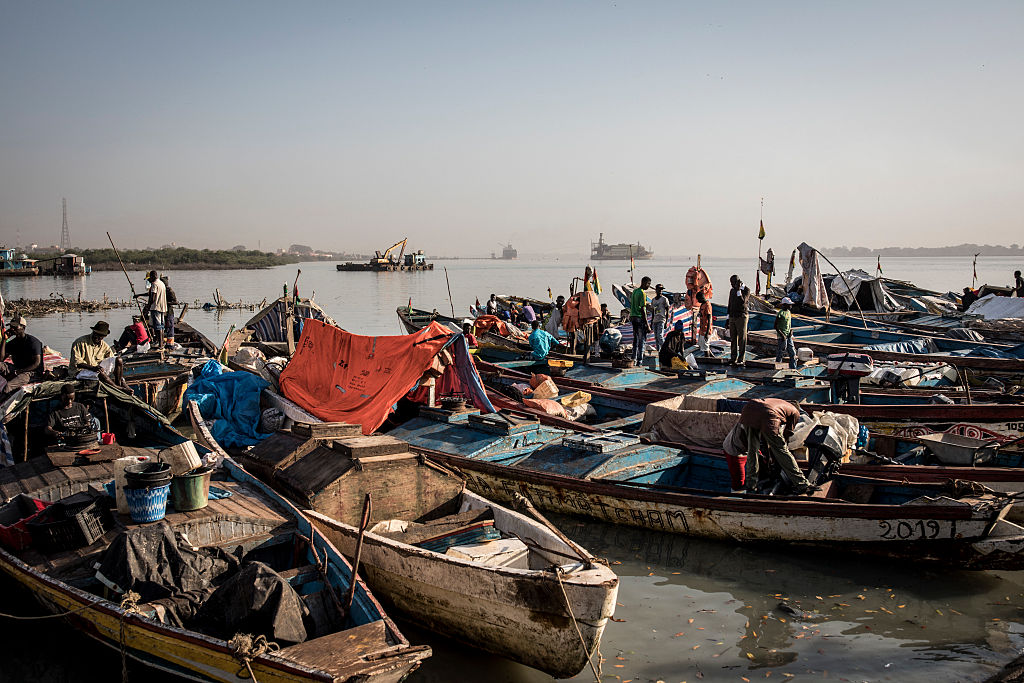
Illegal fishing also threatens the livelihoods of Guinea-Bissau’s approximately 5,600 artisanal fishermen and those working in an informal fishing industry that employs 225,000 people, according to the Coalition for Fair Fisheries Arrangements. Local fish ground into fishmeal and oil often are moved into international supply chains.
“When foreign distant water fleets operating outside the law vacuum up these stocks for fishmeal and fish oil to feed animals instead of feeding peoples in west Africa, the consequences fall hardest on small-scale fishers and coastal communities who have no alternative,” Aliou Ba, an oceans campaigner at Greenpeace, said in The Guardian and DeSmog report.
In late January, Bissau-Guinean authorities suspended licenses for purse seine fishing of small pelagic fish and announced a ban on fishmeal and fish oil production on sea and land. Purse seine fishing involves using a large net to catch dense schools of single-species pelagic fish such as mackerel and tuna. These steps were lauded by neighboring countries, research organizations and environmental groups. However, Dyhia Belhabib, principal investigator of fisheries at Ecotrust Canada, foresees challenges in enforcing the ban.
“I don’t think that a ban will make them disappear,” she said in the joint report. “At this point in time, Guinea-Bissau does not have the capacity to enforce control at sea.”
Chinese vessels have operated illegally in African waters for decades, and Beijing’s distant-water fishing fleet, the world’s largest, is the world’s worst illegal fishing offender, according to the IUU Fishing Risk Index. Due in part to Beijing’s operations in its waters, West Africa loses up to an estimated $9.4 billion to illegal fishing each year.
In Guinea-Bissau and around the continent, Chinese captains routinely hire locals to work on their vessels, but they are commonly treated poorly and abused. A Guinean sailor going by the pseudonym Antonio told The Guardian and DeSmog that he spent seven months on board the Hua Xin 17 in 2024. Antonio shared secretly recorded video footage showing tons of fresh sardinella traveling along an assembly line and said the Guinean crew members were treated badly.
“They don’t see us as equal to them,” Antonio said. “They only gave us rice to eat. Breakfast, lunch and dinner — just rice.”
He said the Chinese crew had their own food and separate rooms, while Guineans slept in bunk beds, 10 to a cabin.