

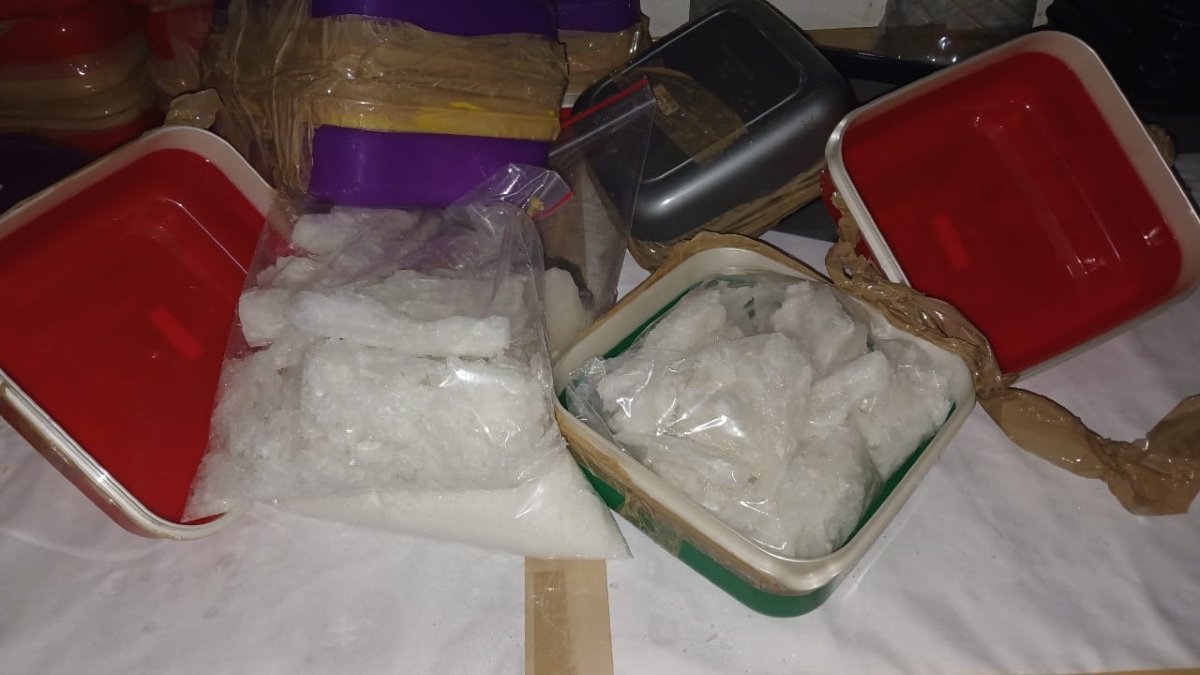
In the past year and a half, South African police have busted three industrial-scale drug labs where they found more than $151 million worth of crystal methamphetamine, known locally as tik. Among the men they apprehended were eight Mexican nationals.
South Africa is one of several African countries experiencing a structural shift in global drug-trafficking tactics with production moving closer to consumer destinations to cut down on cross-border risk. Mexican criminal organizations are playing a key role in African manufacturing operations in South Africa and Nigeria, where industrial meth labs that emerged from 2016 were allegedly developed in collaboration with a Mexican cartel.
Andy Mashaile, a security strategist and retired Interpol ambassador, said cartels increasingly are smuggling raw materials through West Africa and manufacturing drugs in South Africa, particularly in rural areas with minimal police presence.
“There is a concerted effort by transnational organized crime gangs, specifically manufacturing drugs, and we are seeing a change in their modus operandi,” he told SABC News in September 2025. “This is exactly what the Mexicans have done. They have changed their tactics of manufacturing in Mexico and now manufacture in South Africa, which is a serious cause for concern for all of us involved in law enforcement as well as the criminal justice cluster.”
South Africa is home to an estimated half a million people who use illicit drugs, but historically, Western Cape gangs got chemical precursors from Chinese syndicates in return for a Chinese delicacy — poached abalone. The drugs were cooked in small, unsophisticated labs.
Today, the pace of change has overwhelmed law enforcement to the point that South Africa is deploying more than 450 Soldiers from the armed forces to assist police in fighting violent, organized crime, gangs and drugs in the Western Cape, Gauteng and Eastern Cape provinces.
“South Africa’s organized crime landscape is evolving faster than the country can build the institutional capacity needed to address it,” Ryan Cummings, director of the Signal Risk consultancy, told The Africa Report news website for a January 27 article.
Since the late 1950s, West Africa has been a major transit point for drug trafficking from Latin America to Europe. Taking advantage of container ships, lightly supervised ports and fragmented maritime security, traffickers move an enormous volume of drugs and materials through the commercial routes. With North and Central America cracking down on transnational crime, cartels are shifting operations across borders and markets, according to an academic from the Democratic Republic of the Congo who researches organized crime in the region. He asked that he not be identified for security reasons.
“Criminal networks facing shrinking space in the Americas will look for other spaces where risk is lower and returns are opaque,” the academic told The Africa Report, adding that the DRC offers “exactly that mix.”
“The result is not necessarily more drugs moving through West Africa, but a hardening of its role as a dependable link in the chain. Displacement does not stop at transit. It can also reshape where drugs are produced and processed.”
The Africa Organized Crime Index 2025 revealed how organized crime has been expanding across the continent since 2019. During that time, 92.5% of African countries have shown low resilience to organized crime, the Index said, with 23 dealing with the highly dangerous mix of high criminality and weak institutions.
The Index ranked South Africa, Nigeria and Egypt as the continent’s top synthetic drug markets. Nigeria, ranked by the Index as the fifth-most violent country in the world, also is a major destination and transit point for weapons trafficking, another illicit market that overlaps with the global drug trade.
African countries must be proactive in forging new security partnerships, Mashaile said in calling for governments to open dialogues with Central and South American countries.
“We should engage the states where these drugs are manufactured,” he said, urging law enforcement agencies to “devise new strategies, counter intelligence and eradicate the distribution and manufacturing of drugs as well as destroy the new methods by the international drug syndicates.”