
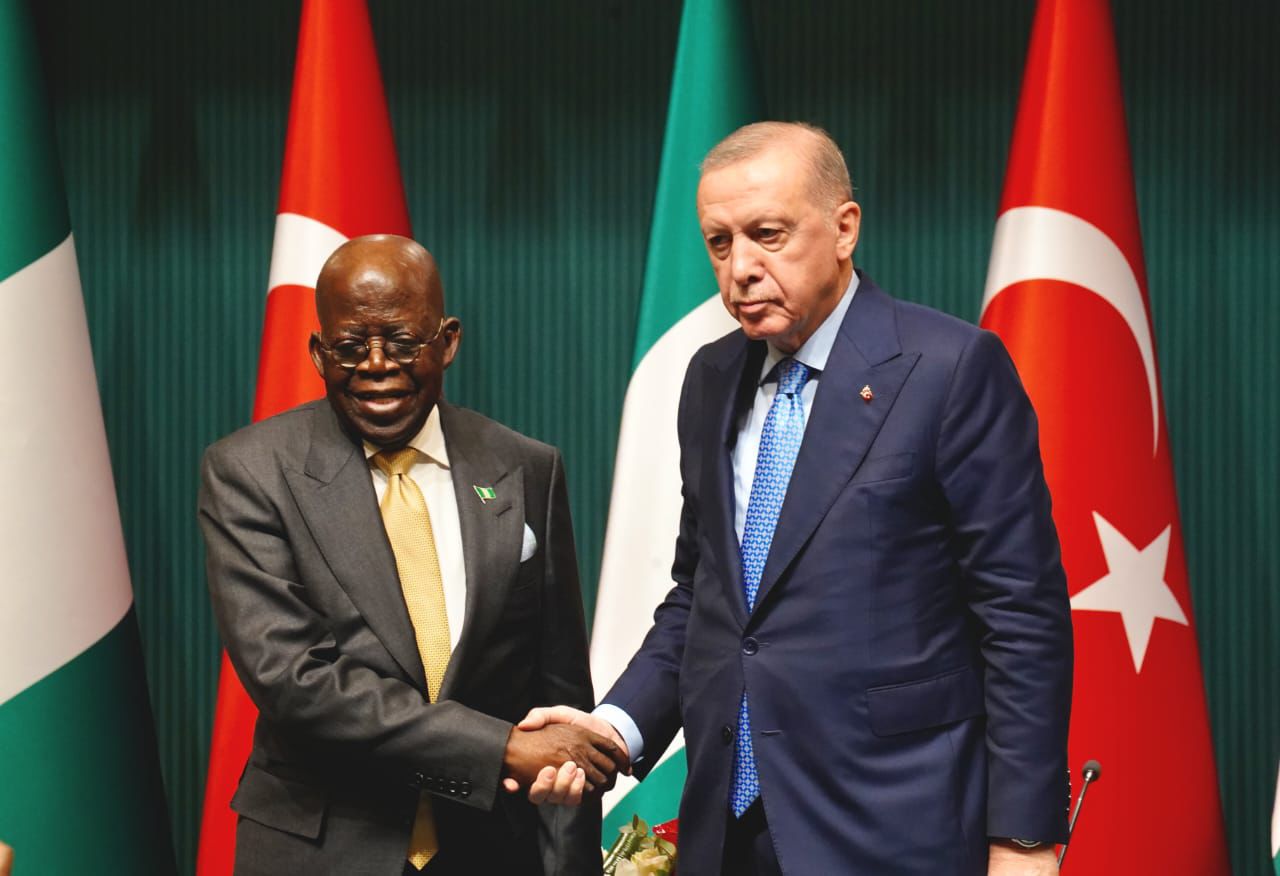
From coast to coast, Turkey is working to forge ties with African nations, often as a security partner for weapons purchases and military training, and as an investor in infrastructure projects. Turkey believes it can position itself as an alternative option able to negotiate sophisticated military deals without any of the drawbacks of partnering with China, Russia or traditional Western allies.
“Ankara acts as a unique geopolitical hybrid: a NATO member with NATO-standard military capabilities, yet a diplomat that speaks the language of the Global South,” Göktuğ Çalışkan, a foreign policy analyst at the Ankara Center for Crisis and Policy Studies, wrote for the Turkish newspaper Daily Sabah.
Due partly to Ankara’s flexibility in exporting drone technology, Turkish arms company Baykar now counts Angola, Burkina Faso, Djibouti, Ethiopia, Kenya, Mali, Morocco, Niger, Nigeria, Somalia, Togo and Tunisia among its clients. These drones are prominently deployed in several conflict zones.
In December 2024, Baykar launched a project to build and maintain multimillion-dollar Bayraktar TB2s and the more advanced Akinci drones in Morocco. While Turkish drone exports are highly publicized, Ankara is quietly reconfiguring its approach in a strategic zone stretching from the Sahel to Senegal, Morocco and the Mediterranean, Çalışkan wrote.
Turkish Prime Minister Recep Tayyip Erdoğan’s Africa Policy employs a mix of security cooperation, economic investment and diplomatic outreach. A vital aspect of this approach has been its strategy of controlling and investing in several African ports. This positions Turkey as a partner in projects aligning with Morocco’s Atlantic Initiative, which aims to provide landlocked Sahel countries with strategic access to the Atlantic Ocean through major infrastructure investments.
“Türkiye has positioned itself as the natural partner in this new architecture,” Çalışkan wrote. “Ankara’s deep ties with Rabat allow it to project power and logistics capabilities from the Mediterranean deep into the Atlantic coast. Every Turkish-built port, highway and logistics hub in Senegal, Mauritania or the Ivory Coast is a tangible stake in this future.”
In late 2024, Metag Holding, based in Ankara, signed a deal to develop Hobyo Port, Somalia’s second-largest seaport, with an initial investment of $70 million that is expected to transform the Galmagud State port into a regional trade center. This will reduce pressure on the Mogadishu Port and offer an alternative route to Ethiopia and Djibouti.
“This port will not only invigorate our regional economy but also enhance trade and connectivity, benefiting the entire nation,” Ahmed Abdi Kariye, head of Galmudug State, said in a report by the Turkey Today newspaper. The agreement includes an operational period of 80 years, during which Metag will manage the port.
Turkey also has direct influence or control of the Mogadishu Port, the Suakin Port in Sudan and several Libyan ports, according to the Observer Research Foundation. Ankara has indirect influence in several ports in Djibouti and Egypt.
“By focusing on ports as epicenters of its outreach in Africa, Türkiye hopes to achieve a series of objectives: control of maritime trade routes due to strategic locations of the ports, expanding its presence in some of the world’s most contested regions like the Horn of Africa and the Red Sea, competing with global and regional rivals,” wrote Yuvvraj Singh, a research intern at the foundation.
Çalışkan says African governments are increasingly turning to Turkey for military hardware and infrastructure projects because deals with Ankara are not opaque — unlike dubious “debt trap” deals with China — and are not attached with political strings or operational restrictions.
Turkish construction companies have completed more than 2,000 infrastructure projects worth $100 billion across Africa, according to the Turkey Journal newspaper. During last year’s Türkiye-Africa Business and Economic Forum in Istanbul, Turkish Trade Minister Ömer Bolat said these partnerships are built on a “fair, equal, and win-win” approach that fosters sustainable growth.
This has coincided with improved air connectivity on the continent. Turkish Airlines now flies to 62 destinations across 40 African countries, while Ankara’s foreign policy aims to build connections not only with states but also with societies, young people, academics, artists, students and local communities.
“Türkiye offers a model of ‘strategic autonomy,’” he wrote. “Ankara’s focus on capacity building through military academies, police reform and technology transfer resonates because it treats African security forces as sovereign entities capable of managing their own defense.”
Several junta-led countries on the Sahel have turned to Russia for security through its paramilitary Africa Corps, but these fighters commit atrocities against civilians alongside state forces. Some analysts contend that the juntas have become too dependent on the Russians, who do not improve security.
In contrast, Ankara “acts as a unique geopolitical hybrid: a NATO member with NATO-standard military capabilities, yet a diplomat that speaks the language of the Global South,” Çalışkan wrote.
Çalışkan says Ankara has built “a reservoir of goodwill” by educating West African students in Turkish universities and delivering health care services directly to underserved communities.
“In a region where anti-foreign sentiment is rising, the Turkish flag is predominantly associated with solidarity,” he wrote. “This grassroots legitimacy creates a symbiotic relationship where security cooperation and societal development reinforce one another.”