

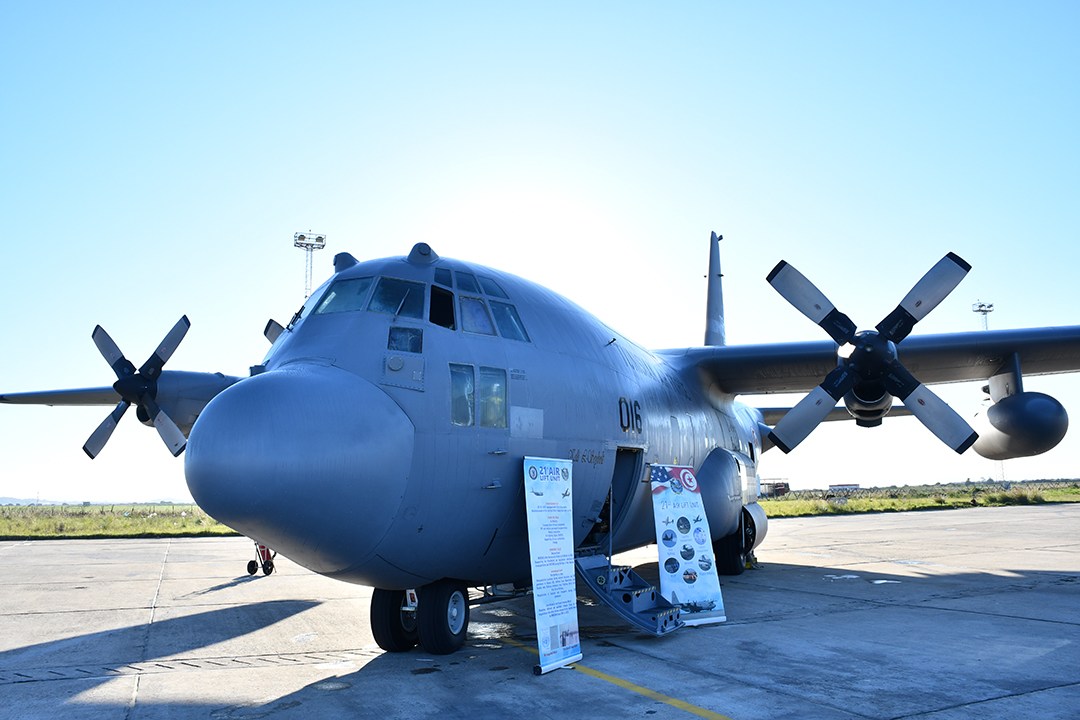
The Tunisian Air Force has taken delivery of a C-130 Hercules transport aircraft, the fourth from the United States since 2021.
U.S. officials handed over the aircraft in a ceremony at Sidi Ahmed Air Base in Bizerte on January 13.
During the ceremony, Tunisian Minister of National Defense Khaled Sehili praised the strategic partnership between the two countries, saying it was based on common interests and mutual respect.
He said Tunisia and the U.S. are working together to develop the operational capabilities of the national army, providing special equipment and supplies, intensifying training and exercise programs, exchanging experiences and providing technical support.
Tunisia is ready to continue and strengthen this cooperation, given its role as a source of security and a key factor of stability in the region, Sehili told the crowd during the ceremony.
Tunisia last took delivery of a C-130H in November 2024. The Air Force now flies five C-130Hs, one C-130B and two newer-generation C-130J Super Hercules that were delivered between 2013 and 2015, defenceWeb reported.
The exchange is the latest in a series of upgrades to the Tunisian Air Force. In September 2024, Tunisia acquired four Textron Aviation C-208B Grand Caravan EX utility planes. They were configured for intelligence missions, with night vision capabilities and other sophisticated surveillance equipment. Tunisia also has obtained eight Beechcraft T-6C Texan II trainers. In addition to training pilots and support staff, the aircraft are used to strengthen security along the southern border, including stopping cross-border smuggling and terrorism.
The aircraft acquisitions have included spare parts, flight training, technical drawings, logistics support and ground support equipment, defenceWeb said.
The transfer of the C-130H came under the U.S. Excess Defense Articles program, which lets the U.S. transfer surplus military equipment to foreign partners as a grant or at a reduced cost. Tunisia’s request for the four surplus planes dates to 2019.
Tunisia and the U.S. have worked together for more than 40 years on C-130 operations, including training and maintenance. The C-130 is a four-engine turboprop military transport plane that first was produced in 1955. The planes typically are 29 meters long with a 40-meter wingspan. They are designed for airlifting troops over medium distances and to be able to land on short, basic airfields. In Africa, they typically are used for troop transport, regional security and counterterrorism operations.
About 70 countries throughout the world have acquired C-130s over the years, including Algeria, Botswana, Cameroon, Chad, Egypt, Ethiopia, Libya, Morocco, Niger, Nigeria and the Republic of the Congo. More than 2,500 of the planes have been produced. The planes have been consistently improved during production, with newer versions climbing faster and higher, flying farther at a higher cruise speed, and taking off and landing in a shorter distance.
UPGRADING MILITARY
Tunisia is upgrading its military infrastructure and acquiring air defense systems and drones, partially because of security problems in other countries in the region, such as Libya and Mali.
“This new endeavor is not merely a military update but a step towards redefining Tunisia’s role in the region, focusing on safeguarding national interests and achieving strategic independence in a changing world,” according to a 2024 report by Maryam Al-Jumaili for the International Center for Strategic Security and Military Studies. “This transitional period requires a comprehensive vision and close cooperation between the government and the people to ensure the success of these initiatives and achieve a safer and more prosperous future in Tunisia.”
As Tunisia upgrades its air fleet, its strategic doctrine remains “strictly defensive,” shaped by its location in North Africa and the instability in neighboring Libya, according to GlobalMilitary.net. Tunisia’s military stance emphasizes border security and countering transnational threats.
The Air Force’s cargo planes provide critical airlift for defense and contribute to humanitarian relief and firefighting capabilities. The Tunisian Air Force has deployed personnel to United Nations peacekeeping missions, including the Central African Republic, for air rescue and transport duties.
Recent Air Force engagements primarily have been for counterterrorism operations, GlobalMilitary.net reports. “These activities heavily involve intelligence, surveillance, and reconnaissance missions to monitor an active insurgency and secure the border regions.”
Tunisia’s last major terrorist attack came in May 2023. Since then, the country has aggressively pursued leads on terrorism, according to news reports. In late January, Tunisian authorities announced that they had dismantled a four-member terrorist cell in a border region near the Tunisian-Algerian frontier. All four members of the cell were killed, according to Middle East Online.
With its Air Force fleet expansion and other military upgrades, Tunisia is “opening a new chapter” amid surrounding security and geopolitical challenges, Al-Jumaili wrote.
“This new endeavor is not merely a military update but a step towards redefining Tunisia’s role in the region, focusing on safeguarding national interests and achieving strategic independence in a changing world.”