
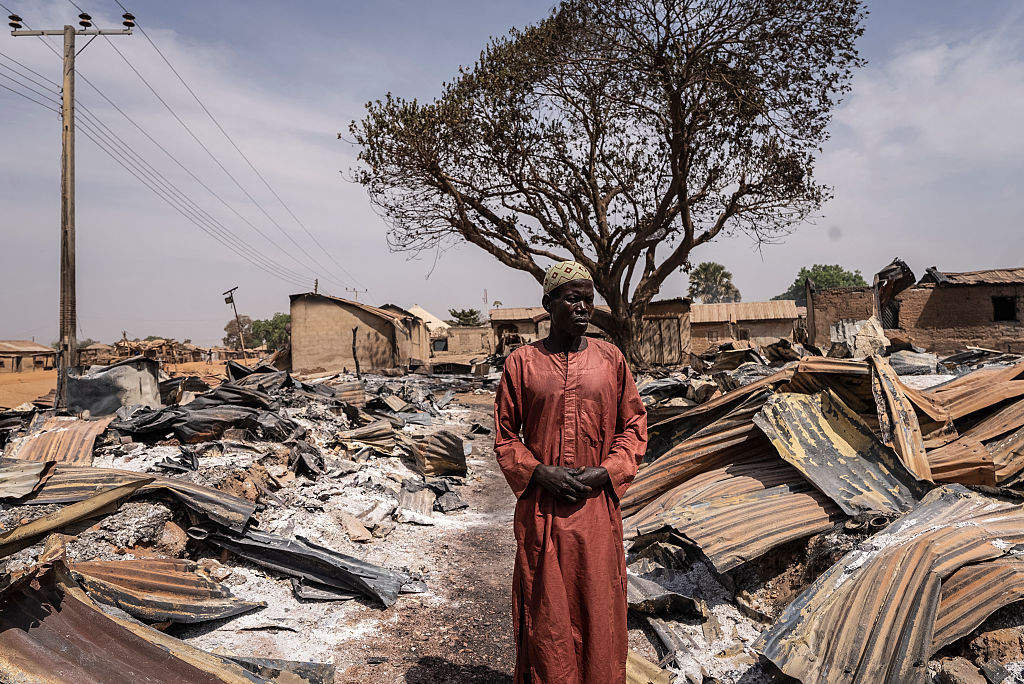
Umaru Tanko stood in the middle of a town reduced to ashes. Outside a charred shop in the western Nigerian town of Woro he told a reporter that the bodies of a friend’s son and grandson lay inside.
“They set them ablaze … but we did them no wrong,” Tanko told Al Jazeera.
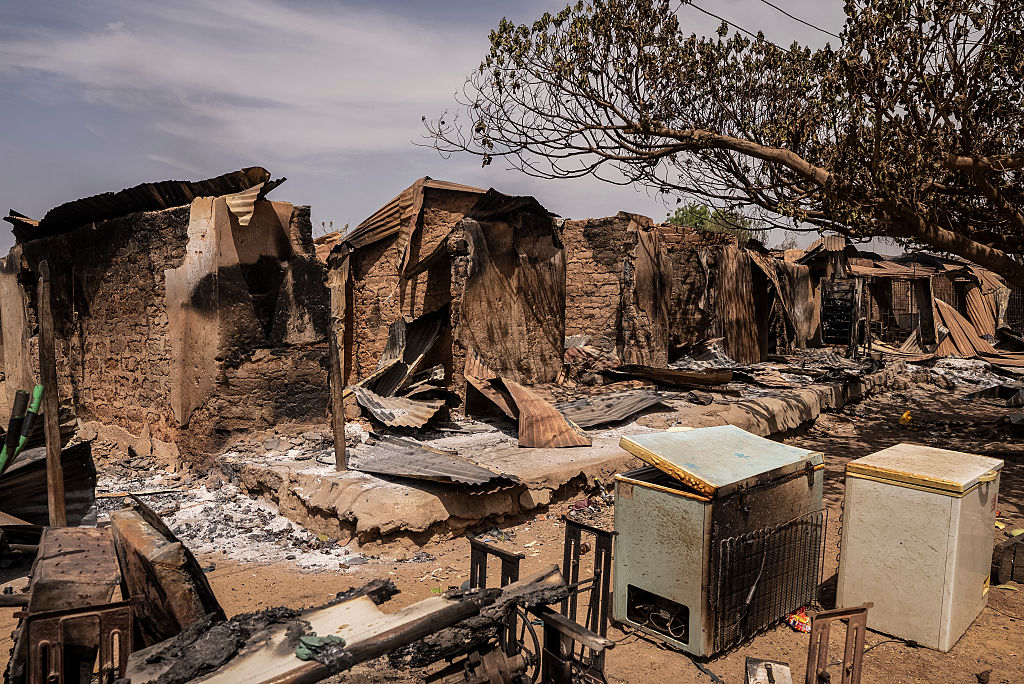
Islamic State group (IS) terrorists leveled the Kwara State community in a February 3 attack. Locals said terrorists targeted them for refusing to allow radical preachers to give speeches in the town. After the violence, only about 200 people remained from a once-bustling town of 17,000.
On February 14, terrorists released a video showing 176 kidnapped Woro residents huddled in a forest, further horrifying the nation. The captives appeared frail and afraid.
“The footage shows dozens of women and children standing in rows, many of them visibly distressed,” according to online news service Sahara Reporters. “Their clothes appeared dirty and worn, while several of the children were seen without trousers, underscoring the harsh conditions under which they are being held.”
The dire situation is not isolated. Nigeria is in a virtual vise, targeted by terror groups in its northwest, north and northeast. The Sahel-based terror group Jama’at Nusrat al-Islam wal-Muslimin (JNIM) claimed its first attack in Nigeria in 2025 and has threatened to push south toward the Gulf of Guinea. Boko Haram and its splinter groups continue to terrorize northeast Nigeria. The scourge of banditry, which has plagued northwest Nigeria, has begun to morph into jihadist violence. The most recent terror group to emerge, Lakurawa, reportedly is a partnership between terrorists and bandits who fund their operations through kidnapping for ransom.
In an analysis of the country’s overlapping security threats, the Vanguard, one of Nigeria’s largest newspapers, calculated that 1,258 people were killed due to violence between January 1 and February 10, 2026.
“From terror attacks and communal clashes to cult violence, armed robbery, auto crashes and domestic tragedies, the killings cut across virtually every geo-political zone,” Clifford Ndujihe, the Vanguard’s politics editor, wrote on February 14. “For many Nigerians, the debate is no longer about statistics but survival.”
U.S. Military Support
In the face of this growing threat, Nigerian President Bola Tinubu has sought to strengthen the country’s security partnerships with historical allies.
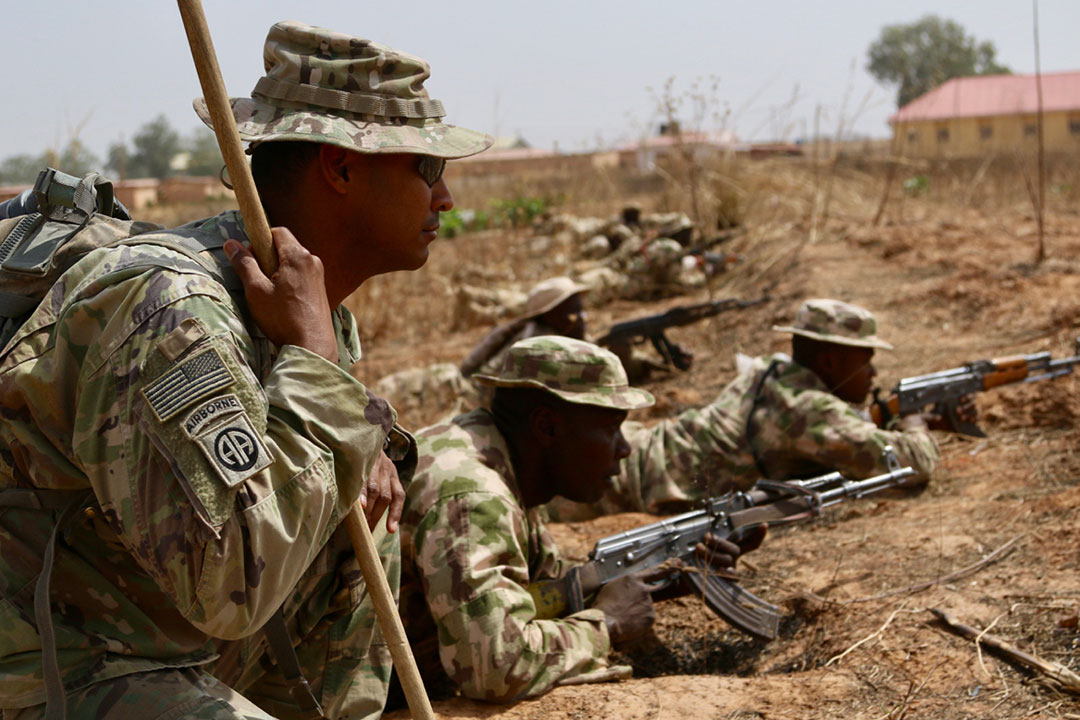
In early February, Gen. Dagvin Anderson, commander of U.S. Africa Command (AFRICOM), confirmed during a press briefing that a small U.S. military team was deployed to Nigeria to support counterterrorism operations.
The deployment stemmed from high-level talks initiated last year, including a meeting between Anderson and Tinubu in Rome where they agreed on the need for coordinated action against regional threats such as IS affiliates and Boko Haram. The meeting took place under the parameters of the Aqaba Process, a Jordanian initiative to promote military cooperation to combat terrorism.
On December 25, 2025, the U.S. launched more than a dozen Tomahawk cruise missiles from a Navy ship operating in the Gulf of Guinea on two terrorist enclaves in Bauni forest in Sokoto State. Nigeria’s ministry of foreign affairs said the “precision hits” stemmed from the exchange of intelligence and strategic coordination between the two countries and was in line with “established international practice and bilateral understanding.”
For its part, Nigeria has announced plans to surge troops to affected areas and reinforce Operation Hadin Kai, its counterterror operation targeting Boko Haram and IS. Nigerian leaders have stressed that they are directing the counterterror efforts in the country.
“Our security alliance with the United States is strategic, focused on protecting vulnerable communities, and operationally led by Nigerian troops,” Tinubu said in a January 26 speech in Kano.
During decades of partnership between the two countries, U.S. forces in Nigeria have increased and decreased, but AFRICOM has maintained a policy against establishing a permanent base in the country. Lt. Gen. John Brennan, AFRICOM deputy commander, reiterated this in an interview with Agence France-Presse. “We are much more focused on getting capability to the right place at the right time and then leaving,” Brennan said.
The U.S. support is part of a long history of military cooperation. In recent years, the U.S. has supplied 12 A-29 Super Tucano light attack aircraft, which are vital to Nigeria’s counterterror efforts, and 12 AH-1Z attack helicopters. The U.S. also funded a modernization project for facilities at Kainji Air Base to service the Tucano planes.
Defence Headquarters Nigeria (DHQ) recently announced the deployment of roughly 200 U.S. military advisors who will provide enhanced counterterrorism training, technical support, and intelligence sharing. Samaila Uba, spokesperson for Defence Headquarters Nigeria, said the U.S. advisors are there for training purposes and will not engage in combat or have a direct operational role. Nigerian forces will maintain complete command authority.
Support Through Training, Logistics and Intelligence-Sharing
Although specific details have not been released, security experts offer insights into the Nigerian DHQ request for training, technical support and intelligence sharing.
Nigeria’s interest in enhanced training could include tactical training for existing Nigerian Army basic training cohorts and existing Army units operating under Operation Hadin Kai as well as supplemental counterterrorism weapons. More than 20 Nigerian Army forward operating bases (FOBs) were attacked or overrun by jihadist militants in early 2025, indicating a need for U.S. military training in fortifying, defending and resupplying a network of remote FOBs.
U.S. military technical support will likely focus on optimizing offensive and intelligence, surveillance and reconnaissance (ISR) drone operations, while also offering expertise in countering terrorist use of improvised explosive devices (IED) and unmanned aerial vehicles (UAVs) that are being deployed against Nigerian troops.
There is also mutual interest in building upon the successes of the joint U.S.–Nigeria Intelligence Fusion Center, a critical facility that strengthens Nigeria’s ISR capabilities. The cell has been credited with building enduring Nigerian capacity and ability to support real-time operational outcomes on the battlefield, thereby enhancing the country’s ability to respond independently to security threats.
A Nigerian security analyst said the support the country needs most is in persistent ISR, intelligence fusion and operational design, not “boots on the ground.”
“If U.S. support is to alter Nigeria’s security trajectory, its greatest impact will be upstream in intelligence generation, fusion and use, rather than downstream in firepower,” Lekan Olayiwola wrote for The Cable. “Intelligence sharing has improved tactical responsiveness in certain theatres, shortening the time between detection and action, especially where insurgent units exploit slow decision cycles.”
CEO of Nigerian tech company Jetlink Group and politician, John Chuma Nwosu, likewise said Nigeria is building an alliance that will give its troops the technological superiority it needs to have the upper hand against terrorists.
“The partnership underscores the growing importance of technology-driven security architecture in modern warfare,” Nwosu told reporters. “In the contemporary security environment, technological superiority plays a decisive role in intelligence gathering, surveillance, and operational efficiency. Any nation that neglects this reality places its citizens at risk.”