
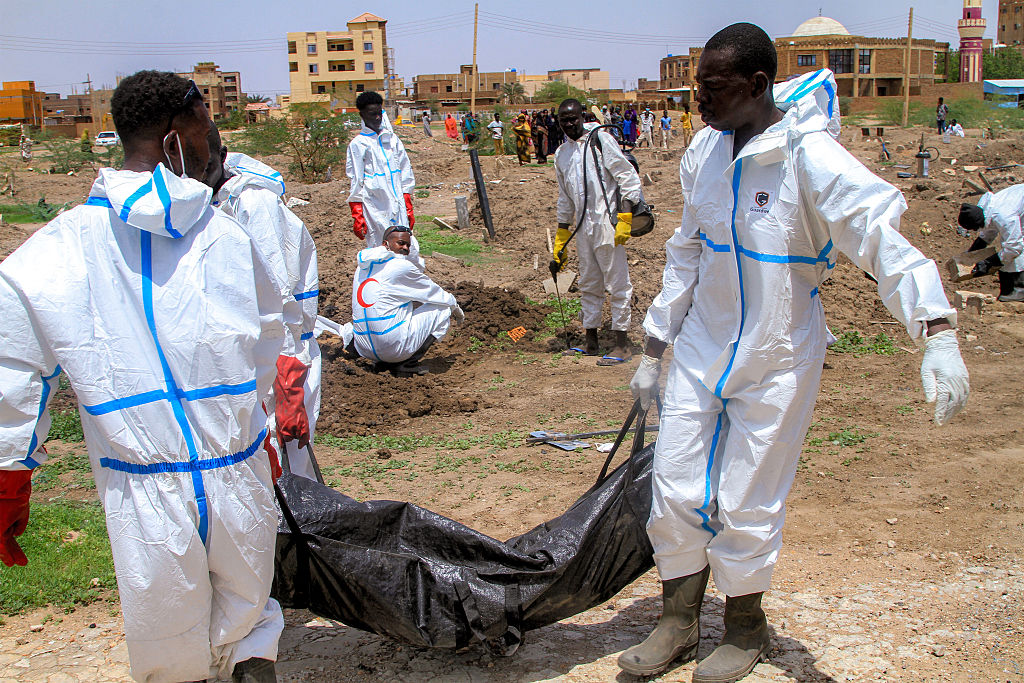
As Sudan’s civil war continues, two mass graves have been discovered around Khartoum, the national capital. Locals say the paramilitary Rapid Support Forces (RSF), led by Gen. Mohamed Hamdan “Hemedti” Dagalo, transferred bodies to the graves from makeshift detention centers.
The victims were civilians and military personnel who were tortured at the centers, Turkish broadcaster TRT World reported. They were transported by other detainees and buried in pits dug with heavy machinery. Their remains suggested that they were buried haphazardly. Sudanese officials are working to open the graves to properly bury the victims but face hurdles.
“The delay in opening the mass graves is due to the enormous number of victims,” Sudanese Attorney General Intisar Ahmed Abdel Aal told Turkish news agency Anadolu Agency. “Efforts are currently underway to open these graves and transfer the bodies to proper cemeteries. The number of those buried is very large, and there are bodies that were buried in schools, universities and public places.”
Abdel Aal said the bodies are being exhumed in coordination with the International Committee of the Red Cross.
“The lack of resources is not the only challenge, but also the high numbers of bodies,” she said. “Mass graves are not limited to Khartoum alone but extend to Wad Madani and large areas of central Sudan.”
The RSF has been mired in a brutal civil war with the Sudanese Armed Forces (SAF), led by Gen. Abdel Fattah al-Burhan, for nearly three years. Both sides are accused of committing atrocities against civilians.
Over three days in late October 2025, the RSF killed at least 1,500 people in El Fasher as it seized the capital of North Darfur State. El Fasher was the last major urban center held by the SAF in Darfur. The Sudan Doctors Network, which tracks the war, described the situation as “a true genocide.”
“The massacres the world is witnessing today are an extension of what occurred in el-Fasher more than a year and a half ago, when over 14,000 civilians were killed through bombing, starvation, and extrajudicial executions,” the group said, adding that the attacks are being carried out as part of a “deliberate and systematic campaign of killing and extermination.”
Many locals believe the RSF and its allied militias aim to transform the ethnically mixed region into an Arab-dominated area. In March 2024, the United Nations Children’s Fund reported accounts of armed men raping and sexually assaulting children as young as 1. That month, Human Rights Watch (HRW) reported that the RSF and its allied militias possibly were orchestrating a genocide in Darfur against the Massalit people and other non-Arab communities.
The RSF also has killed thousands of people in the West Darfur city of el-Geneina in a campaign of ethnic cleansing with the “apparent objective of at least having them permanently leave the region,” HRW reported, adding that it was possible the RSF and its allies had “the intent to destroy in whole or in part” the Massalit people.
On February 15, an RSF drone strike killed three people and wounded seven others at a hospital in southeastern Sennar State.
“Targeting health facilities constitutes a blatant violation of international laws that prohibit attacks on medical centres and health workers,” the Sudan Doctors Network said in a statement. Such incidents “deepen civilian suffering and deprive residents of access to medical care,” the group added.
According to the Sudan Witness Project, the SAF’s Air Force has killed at least 1,700 civilians in attacks on residential neighborhoods, markets, schools and refugee camps. The project analyzed 384 SAF airstrikes conducted between April 2023 and July 2025. The analysis showed that the SAF used unguided bombs in populated areas. The RSF does not have aircraft.
“Sudan’s conflict is really a war against civilians,” Justin Lynch, managing director at Conflict Insights Group, which tracks foreign weapons supplies to Sudan, told the BBC. “Air power and other heavy weapons disproportionately target civilian, more than military, sites.”
The RSF controls all five states of the Darfur region in the west, except for some northern parts of North Darfur that remain under SAF control, TRT World reported. The SAF holds most areas of the remaining 13 states in the south, north, east and center, including Khartoum. The fighting now is concentrated largely in Kordofan, which lies between the two zones of control. Some estimates have placed the war’s death toll at about 150,000. All ceasefire efforts have failed.