
In October 2025, Malagasy protesters met the news of a military takeover with jubilation and validation for their rallies, which had sought the ouster of President Andry Rajoelina.
Then a sober reality set in: life under military rule.
“Often, these successful power grabs are met with applause and support in the streets, as in Madagascar,” researchers Salah Ben Hammou and Jonathan Powell wrote in an analysis for Foreign Policy magazine. “But the veneer of legitimacy often fades as soon as the dust settles. Many coups, after all, are staged not to advance revolutionary demands but to contain them.”
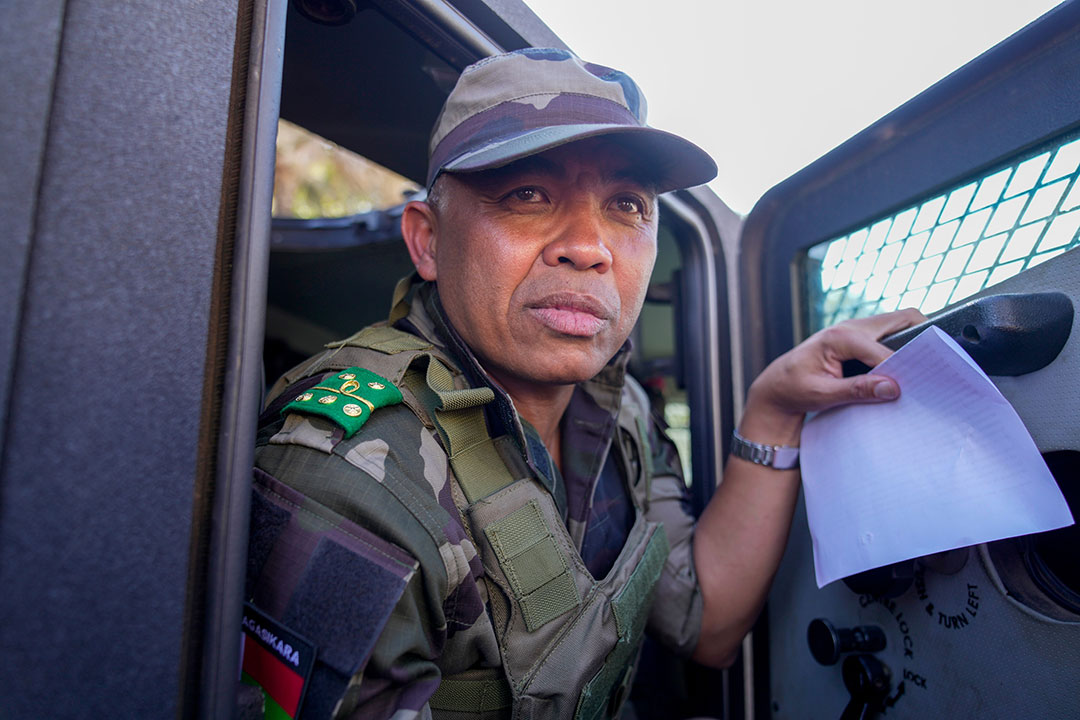
Protests over power outages and water shortages began in late September 2025. Within two weeks, an elite military unit known as CAPSAT and its leader, Col. Michael Randrianirina, threw their support to the demonstrators against Rajoelina, who similarly swept into power in 2009 with CAPSAT’s backing during mass protests. With President Rajoelina in hiding, Randrianirina took control of Madagascar’s military on October 12 and assumed the presidency on October 15.
Teresa Nogueira Pinto, an African affairs expert with Geopolitical Intelligence Services (GIS), described CAPSAT’s role in Madagascar as that of a kingmaker.
“The escalation was incredibly fast,” she said in a January 16 podcast. “In Malagasy politics, when CAPSAT moves, the game is over. They’ve been the decisive factor really since independence. … If CAPSAT sides against you, you don’t survive. We saw it in 2009, and we just saw it again.
“They’re not just any Army unit. They’re an elite corps based strategically near the capital. They control logistics, communications — all the critical infrastructure you need to either run a government or topple one.”
Disillusionment among the Malagasy quickly set in when Randrianirina announced a roughly two-year transition with elections tentatively set for late 2027, disregarding the constitutional requirement for an election to occur within 60 days of a presidential vacancy.
“This is a familiar pattern seen in Africa’s recent putsches, where coup leaders have shown little appetite for stepping aside,” Ben Hammou and Powell wrote. “[It] signals that the military is already veering away from their revolution’s aims and imposing its own will.”
Nogueira Pinto cited CAPSAT’s long history of pragmatism in assessing the junta’s likelihood to prioritize stability, trade and investments by international partners. Madagascar holds strategic significance because it borders the 1,609-kilometer-long Mozambique Channel, a vital East African shipping artery that carries roughly 30% of global tanker traffic.
“It’s a choke point,” she said. “That entire maritime zone has become a key arena for geopolitical and geo-economic competition. Madagascar is smack in the middle of it. [China] sees the island as a key part of their maritime silk road, their Belt and Road Initiative. It’s about securing access and influence across the Indian Ocean.
“But while China is the long-term player, the one filling the immediate vacuum is Russia. They’ve already sent a shipment of weapons to the national guard, calling it ‘lawful international cooperation.’ It’s a clear play to secure a foothold.”
Frustration with the government is nothing new in Madagascar, where public backing rarely seems to last. For now, a new generation is waiting and watching to see if its new military rulers will address demands for an economic lifeline.
“[The coup] threatens to undo years of fragile progress,” the Robert Lansing Institute for Global Threats and Democracies Studies wrote in an October 2025 analysis. “The near future will depend on whether Madagascar’s institutions can reassert themselves, whether the Army truly hands back power to civilians and how the international community balances pressure for democracy with the imperative of stability.”