

In mid-January, Nigerian troops serving in Operation Hadin Kai raided an Islamic State West Africa Province hideout in the Timbuktu Triangle in Borno State. As the troops advanced on the base, armed drones attacked them.
A new report by The Premium Times news outlet suggests that terrorist group, also known as ISWAP, plans to increase its use of armed drones against Nigerian military forces in the northeast. The report appeared as Nigerian troops are increasing pressure on ISWAP across Borno, Yobe and Adamawa states. On several occasions in January, troops fought with ISWAP forces and cleared abandoned hideouts, according to Nigerian security analyst Zagazola Makama.
Troops fended off an ISWAP attack on a base in Damboa area of Borno on January 13. They responded a few days later by raiding the camp and driving out the terrorists. During that operation, troops came under what military sources described as “a rare and worrying attack by a terrorist-operated armed drone,” according to Makama’s reporting on X.
ISWAP followed up with an attack on a military outpost on Jan. 22.
Makama reported that the Nigeria military killed 22 ISWAP terrorists in January during Operation Hadin Kai.
Borno State has been the core of activity by Islamic terror groups, including ISWAP, which broke away from Boko Haram in 2015. Evidence suggests ISWAP began using drones for surveillance and intelligence-gathering in 2020.
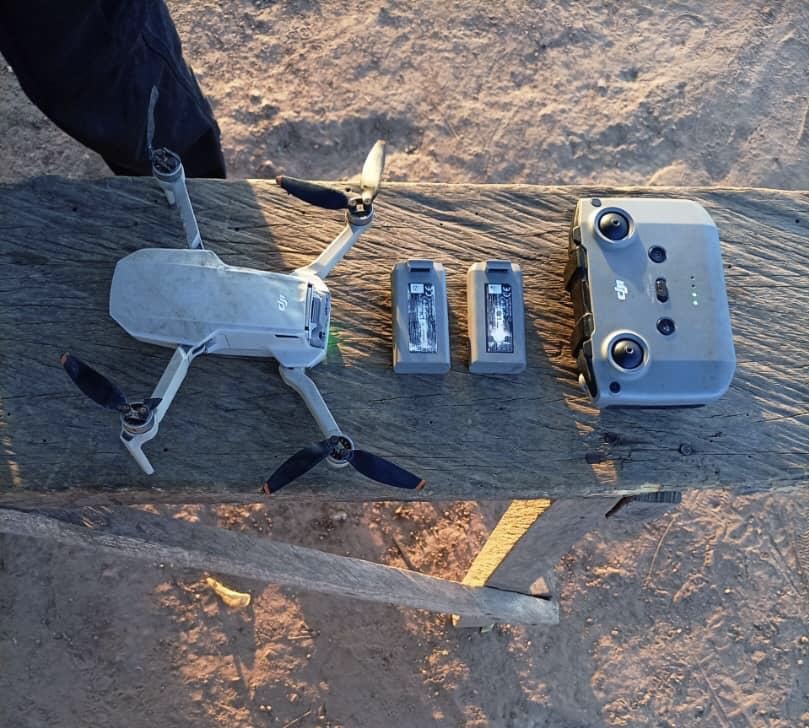
In late December, Defense News Nigeria published a picture of a quadcopter drone, batteries and a controller captured after a firefight with ISWAP fighters. The drone was not armed and appeared to be used for observation.
“Over the years, their drone operations have shown an increasing sophistication, and the group has collaborated with IS [Islamic State] to gain tactical and operational assistance,” analyst Nina Kurt wrote in July 2025 for the Global Network on Extremism & Technology.
Terror groups have used commercially available drones for surveillance and reconnaissance for years. More recently, they have begun converting some of those drones into flying improvised explosive devices (IEDs) by attaching mortars and grenades. In December 2024, Makama published images on X of armed drones that ISWAP used to attack Nigerian troops’ Forward Operating Base Wajiroko in Damboa.
The Premium Times report revealed that ISWAP fighters operating in the Timbuktu Triangle and Sambisa Forest acquired 35 drones via Lake Chad. The porous borders of the Lake Chad region allow the smuggling of weapons such as drones that are part of terror groups’ asymmetric warfare against both soldiers and civilians.
“This development represents a dangerous escalation in Nigeria’s war against terrorism,” Daniel Nduka Okonkwo wrote for Sahara Reporters, regarding ISWAP’s use of armed drones.
Nigerian security forces have used drones for their own surveillance of terror groups. In April 2025, the military launched its first domestically developed weaponized drone, the Damisa, capable of attacking terrorist locations. The drones were specifically designed to carry explosives.
The military has also adopted the Lithuanian-made DM4S SkyWiper electronic warfare system to scramble drones’ control signals.
The evolution of ISWAP’s drone strategy echoes other terrorist groups on the continent that have begun deploying armed drones against government forces in Burkina Faso, the Democratic Republic of the Congo, Kenya, Libya, Mali, Mozambique, Nigeria, Somalia and Sudan.
“These terrorist groups do not operate under the rules of faith, law, or morality,” Okonkwo wrote. “They recognize no limits to warfare, only destruction, chaos, and civilian suffering. They are attacking humanity.”