

Illegal mining by Chinese companies in Nigeria is undercutting the nation’s economy, degrading the environment and driving residents from their homes in part by exploiting weak regulations and corrupt security forces, according to a new analysis.
The report by Renevlyn Development Initiative (RDI), a Nigerian nongovernmental organization, titled “Silent Conquest: The Chinese Infiltration of Nigeria’s Solid Minerals Sector,” focuses on mining between 2018 and 2025. It pays particular attention to the period since 2022, when Nigeria put more emphasis on mining minerals to diversify an economy dominated by oil and natural gas.
Researchers studied mineral-rich states — Kogi, Kwara, Nasarawa, Niger, Osun, Plateau and Zamfara — where illegal mining and foreign involvement by Chinese companies are prevalent.
“In many host communities, illegal operations have turned farmlands, forests and riverbeds into unregulated extraction fields, causing environmental degradation, increasing social tension, and depriving the government of substantial revenue,” the report states.
A lack of effective government enforcement has allowed foreign miners to operate with little regard for standards or community welfare, according to RDI.
“The broader implication is that Nigeria’s control over its strategic mineral resources is eroding from within,” the report states.
Nigeria’s mines produce a variety of valuable minerals such as lithium, fluorite, tin, titanium and lead as well as rare-earth minerals cerium, lanthanum and thorium, used in modern technology. RDI notes that the country’s mineral resources represent a largely untapped economic resource estimated to be worth $700 billion. Yet mining contributes less than 1% to Nigeria’s gross domestic product. By comparison, oil and gas provide 90% of Nigeria’s GDP.
“Despite its potential to drive economic growth and diversify Nigeria’s revenue streams beyond oil and gas, the sector faces significant threats from illegal mining operations,” the report said.
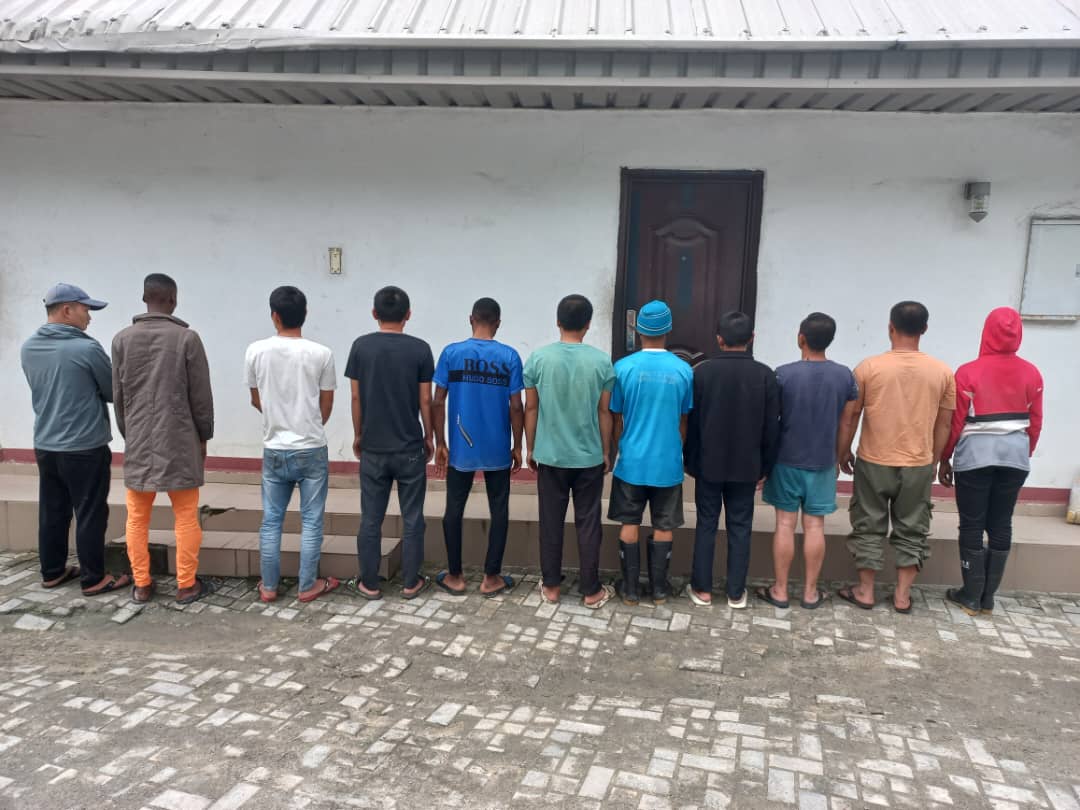
In recent years, Nigerian authorities have made multiple arrests of Chinese nationals involved in illegal mining. In July 2025, officials arrested seven Chinese nationals for mining without permits in Akwa Ibom state on the Atlantic Coast. Others have been arrested in Nasarawa and Plateau states. Many of those Chinese nationals entered Nigeria on tourist visas before illegally working in the mining sector.
The peril of illegal mining by Chinese companies goes beyond economic harm, according to RDI. It also feeds insecurity by empowering criminal groups, creating new trafficking routes, and destabilizing parts of Nigeria’s North-West and North-Central regions, the analysts wrote.
“This pattern underscores the urgent need for decisive governance reforms and stronger oversight mechanisms to prevent the solid minerals sector from becoming another chapter in Nigeria’s long history of resource mismanagement,” the report noted.
According to researchers with ENACT, the involvement of armed groups in illegal mining in Nigeria has worsened arms smuggling and violent conflict across the country and the broader Sahel region. It has also led to a rise in the kidnapping of women and girls for forced labor in mines.
RDI analysts urged government officials in July to strengthen the nation’s control over its mining sector. They repeat that call in their more recent report, urging the government to take a more aggressive stance toward illegal mining by jailing those convicted of it and confiscating both mining equipment and extracted materials.
Among other changes, the RDI recommends:
- Ensuring Chinese and other foreign mining companies are properly licensed and penalized for breaking the law.
- Tightening up the issuing of tourist visa to Chinese nationals to limit their ability to work in the mining sector and overstay their visas.
- Strengthening the National Environmental Standards and Regulations Enforcement Agency’s capacity for holding illegal miners to account for the environment damage.
“Without firm and coordinated government action, the sector risks slipping further into the hands of unregulated actors who undermine national security and deprive the country of significant revenue,” RDI analysts wrote.