
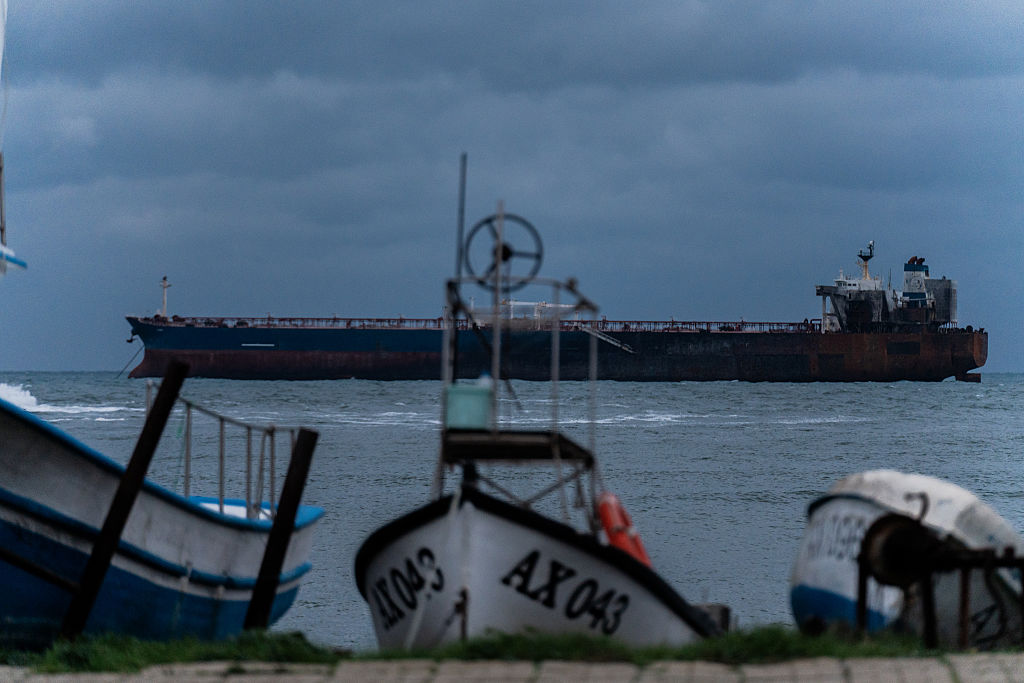
The Mersin, a Turkish-owned oil tanker that recently had visited a Russian port, was hit by four explosions while at anchor in waters off Dakar, Senegal, on November 27. No one was injured, and no pollution was reported.
The Panamanian-flagged ship, which held 39,000 tons of fuel, is suspected to be part of Russia’s “shadow fleet” of aging commercial vessels used to evade Western sanctions on oil exports and, experts say, traffic arms to African conflict zones.
The attack was believed to be carried out by Ukraine, which has been at war with Russia since Moscow invaded in February 2022. Ukraine has not claimed responsibility for the attack, and the ship was not on a list of sanctioned vessels.
“Under the law of armed conflict, belligerents must distinguish between civilian and military targets,” Basil Germond, a specialist in international and maritime security at the University of Lancaster in the United Kingdom, told France 24 television news channel. “That said, historically, in total wars such as the two world wars, commercial shipping was often targeted as part of economic warfare. So, energy exports can be considered as strategic objectives — similar to Russia’s attacks on Ukraine’s energy grid or Ukraine’s attacks on Russian refineries.”
Dirk Siebels, a specialist in maritime security at the Risk Intelligence consulting firm, said Ukraine probably would see the Mersin as a legitimate target. Exports of large quantities of oil help Russia fund its war with Ukraine.
“From a Ukrainian point of view, of course, that’s still something that finances the Russian government — and therefore the Russian war effort in Ukraine,” Siebels told France 24.
The explosions on the Mersin unfolded amid a series of attacks on commercial ships suspected of belonging to Russia’s shadow fleet, most of which lack proper insurance; often change flags, owners and operators; and transship oil at sea to conceal its origin. France 24 recorded seven attacks on vessels linked to Russia between December 2024 and December 3, 2025. These attacks occurred off the coasts of Italy, Libya, Russia, Spain and Turkey.
On December 19, Ukraine used drones to strike the Qendil, an oil tanker in Russia’s shadow fleet in the Mediterranean Sea. The badly damaged ship later docked off Libya’s coast, although it was unclear exactly where the empty ship was attacked. Reuters reported that the Secret Service of Ukraine was behind the attack.
“This development reflects a stark expansion of Ukraine’s use of uncrewed aerial systems against maritime assets associated with Russia’s sanctioned oil export network,” British maritime risk-management group Vanguard said.
In early December, an alleged Ukrainian drone attack struck the Kairos oil tanker, a Gambian-flagged vessel believed to be part of Russia’s shadow fleet, as it sailed from Egypt to Russia off the coast of Bulgaria.
The European Union Council on December 18 imposed sanctions on 41 Russian vessels, bringing to nearly 600 the number of sanctioned ships in the shadow fleet, which has more than 1,100 tankers, according to the Foreign Intelligence Service. The majority of the tankers are registered in three countries: Russia, where 14% are registered; Liberia, 11%; and Sierra Leone, 9%. Experts say the fleet’s vessels often register in countries with low levels of regulation and transparency.
In a move against the shadow fleet, Liberia in 2024 announced it would no longer authorize insurance coverage from Russia’s Ingosstrakh Insurance Co., a primary insurer of vessels in the fleet.