
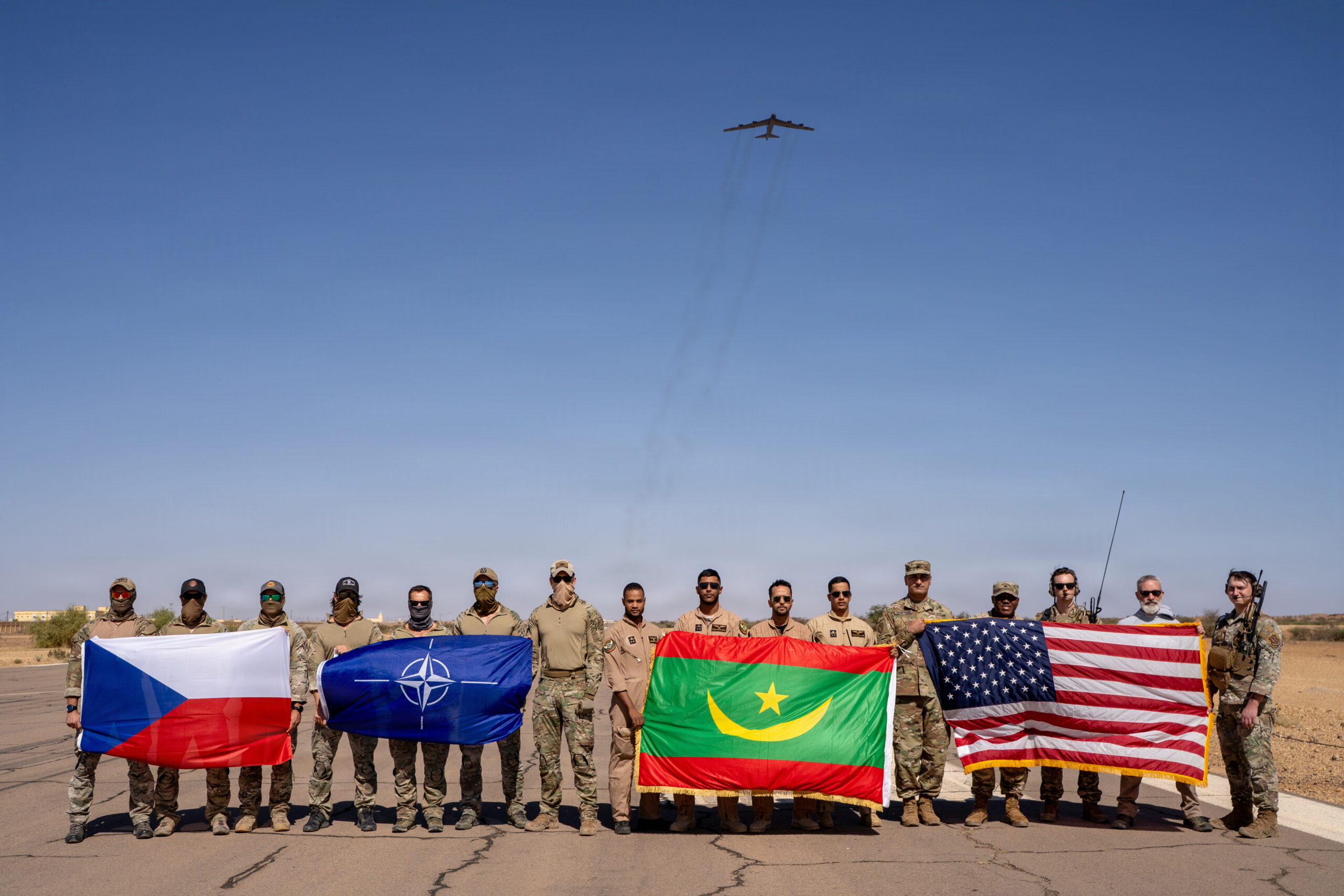
To help Mauritania address growing security threats from the Sahel region and West Africa, the United States government in December 2025 donated a shipment of operational military equipment which will enhance field performance during upcoming military exercises, such as Flintlock 2026, which will be held in Libya and Côte d’Ivoire.
Mauritanian political figure Daddai Bibaut noted that U.S. support has helped keep Mauritania free of terror attacks since 2011, although there are encroaching cross-border security threats, including those from the Jama’at Nusrat al-Islam wal-Muslimin (JNIM) terror group. JNIM in August 2025 captured the Malian town of Farabougou, near the Wagadou Forest. The forest on the Mauritanian border is a known JNIM base.
“This support reflects a clear American desire to deepen the partnership with a country that has proven itself as a reliable partner in a region characterized by increasing unrest and security challenges,” Bibaut said, according to Moroccan online news website Hespress about the equipment donation.
At a handover ceremony, Corinna Sanders, chargé d’affaires at the U.S. Embassy, reaffirmed the U.S. government’s commitment to supporting regional peace, security and stability.
“Bilateral cooperation goes beyond providing equipment, training, and technical support to include enhancing interoperability between the armed forces, building a long-term partnership capable of addressing traditional and non-traditional threats, and establishing a stable security environment that benefits both countries,” Sanders said in the Hespress report.
Bibaut said the U.S. government also has offered support to the Mauritanian Air Force, particularly in the maintenance of surveillance and reconnaissance aircraft, “which ensures the effectiveness of missions despite the limited size of the air force.”
A month before the equipment donation, U.S. Africa Command (AFRICOM) conducted a ground-to-air training event with the Mauritanian Air Force in Atar. The training included multiple simulated bombing runs.
“Such training is not just about building capacity,” Maj. Gen. Justin Hoffman, AFRICOM’s director of operations, said in a news release. “It’s about ensuring interoperability with our partners in a complex security environment and projecting the power necessary to deter threats and defend our mutual interests.”
Security experts have lauded Mauritania’s security strategy. From 2005 to 2011, the country was targeted by extremist groups linked to al-Qaida, which attacked military personnel, foreign embassies, and killed and kidnapped Westerners. In response, Mauritania created special intervention groups, highly mobile military units capable of operating in the desert with light aircraft support, and established scattered checkpoints across the country.
“The key question for them was how to move in a desert environment,” Mohamed Fall Ould Bah, of the Center for Studies and Research on the Western Sahara, told The Arab Weekly newspaper.
Mauritania’s camel-mounted Soldiers gather intelligence in the eastern desert region and maintain a state presence among nomadic populations.
“Mauritania has maintained an effective human intelligence network, particularly notable in the eastern border region known as the Hodh Ech Chargui,” the U.S. Department of State said in its 2023 terrorism report.
Mauritania also mounted a government-led theological dialogue to prevent the radicalization of civilians.
“In an ideological battle, you have to produce a counter-narrative,” Amadou Sall, a researcher at the Mauritania Perspectives think tank, told The Arab Weekly. “There must be an alternative discourse to the jihadist interpretation. Mauritania mobilized the national clergy to provide doctrinal responses to all the points jihadists rely on.”