
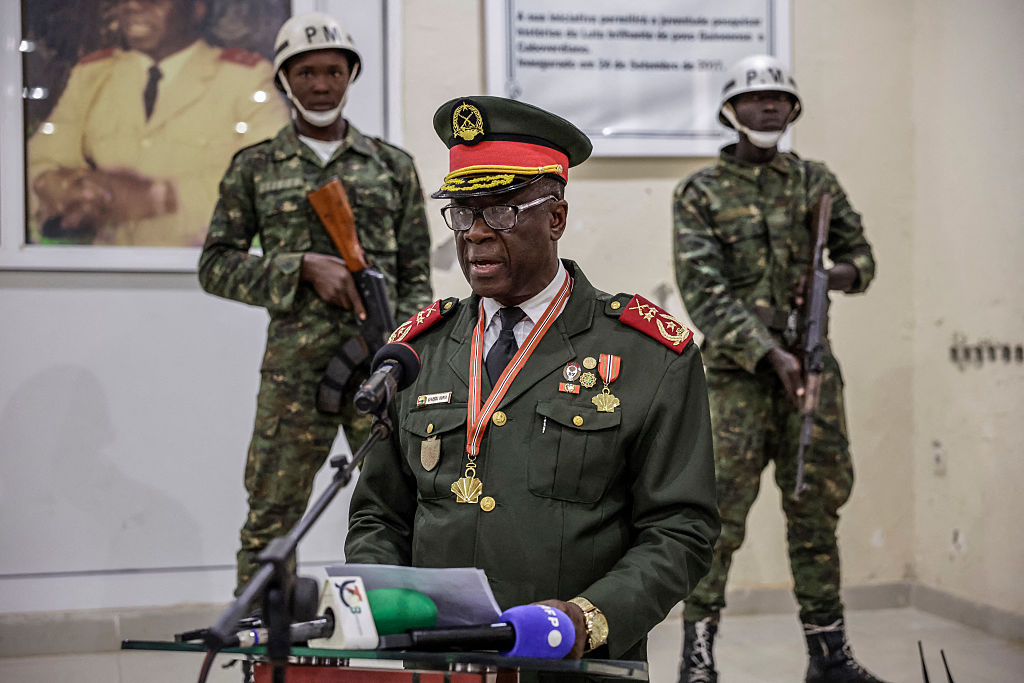
Former Nigerian President Goodluck Jonathan was serving as an election observer in Guinea-Bissau when a group of military leaders declared a coup — the latest upheaval in the West African country’s tumultuous history.
Shortly after soldiers appeared on the streets of the capital, Bissau, and gunfire rang out around his residence on November 26, 2025, President Umaro Sissoco Embaló told media outlets that he had been deposed. Jonathan was among many who questioned the timing of staging an uprising the day before election results were to be announced.
“This was not even a palace coup,” he told reporters. “It was a ceremonial coup conducted by the head of state himself. A military doesn’t take over governments and allow the sitting president that they overthrew to address press conferences and announce that he has been arrested.”
Senegalese Prime Miniter Ousmane Sonko joined the chorus of suspicion, telling lawmakers in his country: “What happened in Guinea-Bissau was a sham.”
Embaló claimed to have won a second term before he announced his ouster, while junta leaders said they seized power and suspended the election after discovering what they said was a conspiracy to manipulate the results that involved “some national politicians with the participation of a well-known drug lord, and domestic and foreign nationals.”
The junta moved swiftly to install a transition leader, tapping Maj. Gen. Horta Inta-A, whom Embaló appointed as his army chief of staff in September 2023. Embaló’s campaign manager and finance minister, Ilidio Vieira Te, was elevated to prime minister and will oversee what was promised as a one-year transition.
Beverly Ochieng, senior security analyst at Control Risks consulting firm, said both men are part of the deposed president’s inner circle.
“It was carried out by people who are Embaló’s close allies in the military,” she told The Associated Press, adding that another junta leader, Dinis N’Tchama, had been the ex-president’s personal military advisor. “The sentiment coming out from the opposition and civil societies is that it was staged because Embaló was losing his grip on power.”
Guinea-Bissau has had four coups and several attempts since achieving independence in 1974. Known as a transit hub for drug trafficking between Latin America and Europe, Guinea-Bissau was labeled a “narco-state” by the United Nations in 2008 because of its role in the international cocaine trade.
Independent opposition candidate Fernando Dias charged Embaló with staging the coup because he knew he would lose the election.
“Umaro lost the elections, and instead of accepting the result, he fabricated a coup d’état,” he said in a video posted on social media. “He couldn’t handle defeat, so he sent the presidential guard and the forces of the Ministry of the Interior to arrest me. I had to escape through a back door.”
Embaló had been in power since 2020. During that time, he claimed to have survived three coup attempts, most recently in October 2025. Critics accused him of fabricating putsch attempts and using them to justify repressing opposition.
Gunfire was heard for hours in Bissau in December 2023 as Embaló’s presidential guard clashed with the National Guard. Two men died in the fighting, which the president said was an attempted coup. He dissolved parliament, and Guinea-Bissau has not had a properly functioning legislature since.
At the time, many believed it was an exaggerated pretext for consolidating power. Observers have noted the parallels between that attempt and November’s successful coup.
“This feels like déjà vu,” political analyst Emman Etuk told The Africa Report. “The script is identical, but the stakes are now exponentially higher. Every time Guinea-Bissau reaches a critical democratic moment, the same actors appear, the same narratives unfold, and the same shadows move behind the curtain.”