
The Kenya Navy in late October seized 1,024 kilograms of methamphetamine from a vessel it intercepted 630 kilometers off the coast of Mombasa in the Indian Ocean. Authorities hailed it as a record haul.
Drug trafficking, piracy, and illegal, unreported and unregulated fishing are ongoing threats in East African waters and theWestern Indian Ocean. Exercise Usalama Baharini 2025, a maritime security training operation held November 17 to 20 at the Bandari Maritime Academy in Mombasa, was meant to address such threats.
The first Usalama Baharini exercise was in May 2024. Usalama Baharini means “safety at sea” in Swahili.
European Union Naval Force Somalia, commonly known as Operation Atalanta, conducted the exercise and aims to improve maritime security in the Western Indian Ocean and Red Sea.
Participants included Kenya’s Navy, Coast Guard, the Directorate of Criminal Investigations’ Anti-Narcotic Unit, Maritime Authority, Ports Authority, Wildlife Service, Fisheries Service, Forest Service, National Intelligence Service, Office of the Director of Public Prosecutions, and Interpol.
Brig. Mohamed Shemote, commander of the Kenya Navy fleet, said the exercise is critical in improving collaboration and interoperability among participating partners.
“This exercise will sharpen our capacity to detect, deter and respond to a wide spectrum of maritime threats including piracy, smuggling, illegal fishing and terrorism,” Shemote said in a news release. “Exercise Usalama Baharini provides a vital platform for collaboration between naval forces, law enforcement agencies and regional partners. Through this unity of effort, we strengthen our readiness and build a more resilient shield over our shared waters.”
Conferences began with a seminar on counternarcotics operations and the rules of engagement in maritime interdiction. Other seminars focused on human rights and law enforcement at sea, illegal fishing, and one on prosecutions, which was led by experts from Operation Atalanta and the Kenya Fisheries Service. Interpol experts led sessions on exchanging information in international investigations, crime scene preservation and an introduction to evidence collection for first responders.
The Kenya Navy led workshops on counterpiracy measures, high seas jurisdiction, maritime interdiction operations and the use of force. Wildlife and forest service officials discussed protecting critical maritime habitats and species living in protected areas. Other sessions focused on theory in escalation of force, tactical communication and interagency communications.
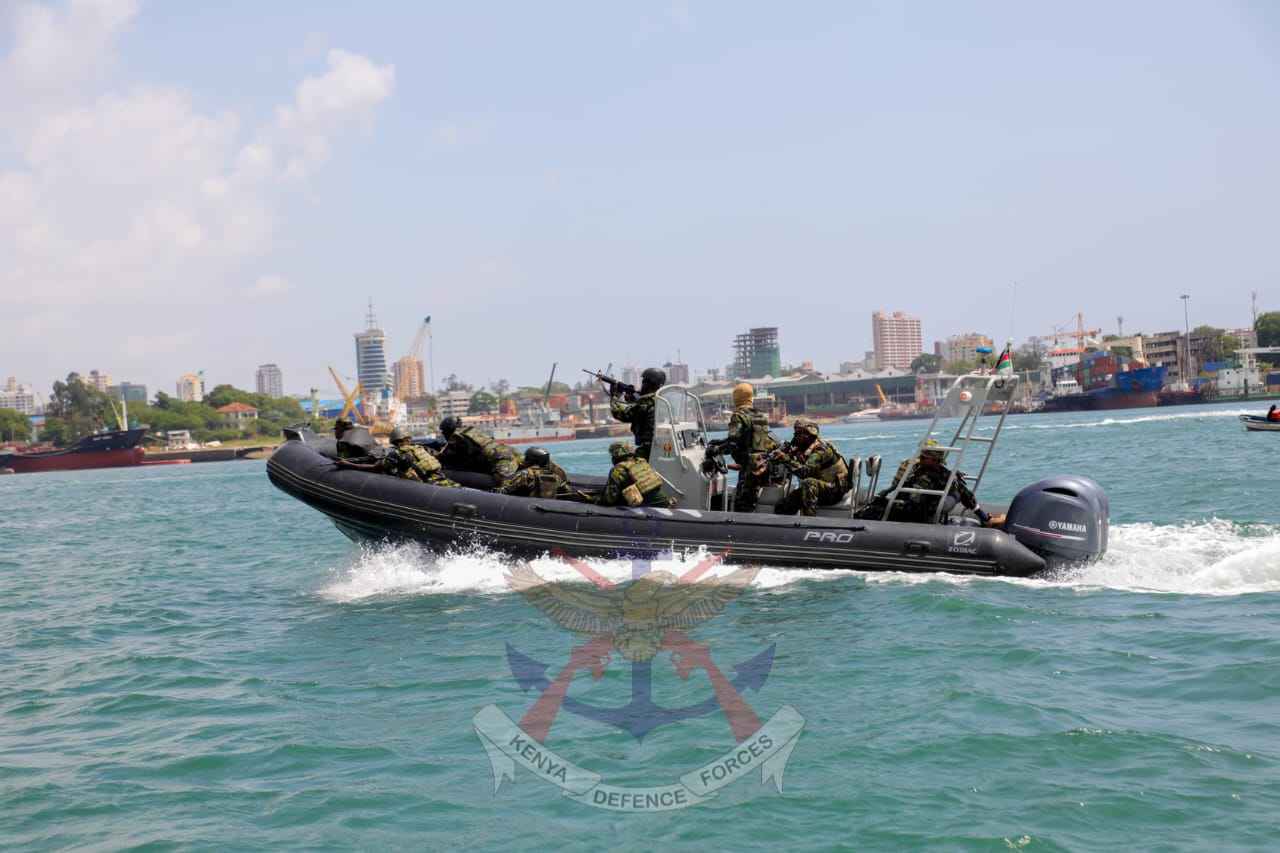
Tactical exercises focused on visit, board, search and seizure drills; noncompliant boarding scenarios; handling restrained detainees; tactical entries; and tactical high-speed maneuvers. The exercise’s final day involved a drill in which Kenyan forces, including an anti-narcotics unit, seized a pirate mother ship carrying narcotics and skiffs used to board civilian vessels.
Cristina Barrios, head of political press and information at the EU Delegation to Kenya, commended the continued cooperation between the EU and its maritime partners.
“The European Union remains committed to supporting Kenyan agencies to enhance their maritime security capabilities,” Barrios said in a news release. “This exercise demonstrates the power of teamwork and shared commitment among participating partners. We are not only united by strong institutional frameworks grounded in international law but also by our practical cooperation to keep our maritime spaces safe.”