
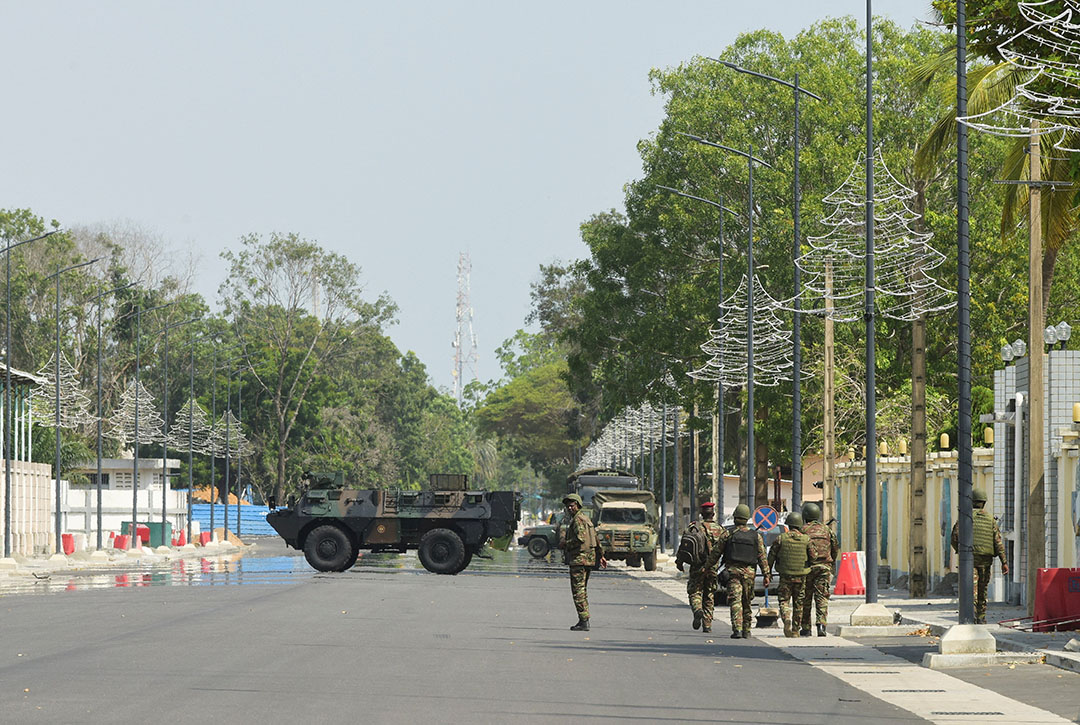
West Africa’s eighth successful coup in the last five years took place in Guinea-Bissau on November 26. Just 11 days later, the too-familiar sight of uniformed Soldiers appeared on Beninese state television just after 2 a.m. on December 7, as a mutinous faction of the military announced their putsch.
This time, the Economic Community of West African States (ECOWAS) swiftly took military action to intervene.
“Beninese loyalist forces repelled the initial assault, but the situation required careful handling to avoid needless civilian casualties,” Beninese Foreign Minister Olushegun Bakari said in a briefing on the sidelines of a scheduled ECOWAS meeting on December 12 in Abuja, Nigeria. “We sought support not because our army was incapable, but because President Patrice Talon wanted to prevent heavy loss of life.”
Nigerian fighter jets scrambled to patrol Benin’s airspace at Talon’s request and launched attacks against the seditious Soldiers who were holed up at the TV station and at Camp Togbin military base near the airport in Cotonou, the country’s largest city. ECOWAS deployed Soldiers from Côte d’Ivoire, Ghana, Nigeria and Sierra Leone.
In using its Standby Force to thwart the Benin coup, ECOWAS demonstrated its ability to preserve peace in West Africa, a region beset with recent unconstitutional military takeovers.
Since 2020, 11 coups across Africa have been successful, the majority of which have been in the Sahel. The coup attempt in Benin was the fifth to have failed over the same period.
Paul Melly, a West Africa analyst with the BBC, said the attempted coup in Benin differed from previous coups within ECOWAS member nations and presented more favorable circumstances for a forceful intervention.
“In acting so quickly, ECOWAS has perhaps learned a lesson from its misjudged response to the 2023 coup in Niger,” he wrote in a December 9 article. “On that occasion it was not practically organized to intervene militarily in the hours after the elected head of state, Mohamed Bazoum, had been detained by coup leaders — the only moment, perhaps, when a rapid commando raid to rescue him and secure key buildings might have had any chance of success.
“This time around, in Benin, the situation was quite different: Talon was still in full control, even if some would-be putschists were still resisting. So he, as the internationally recognized president, could legitimately request support from fellow member countries in the regional bloc.”
Within nine hours, government officials had declared an end to the uprising. Talon appeared on state television later that evening to assure the return of peace and stability. He credited the rapid mobilization of forces that “allowed us to thwart these adventurers.”
Analysts said the coup perpetrators had military and economic grievances but badly misjudged public desire for regime change. Beninese government leaders heaped praise upon the professional troops who were first to fight back and protect key officials.
“Not all the armed forces were on board,” political analyst Ryan Cummings told Al Jazeera for a December 16 article. “There was division within the army, and that was the window of opportunity that allowed ECOWAS to deploy. … I dare say that if there were no countercoup, there was no way ECOWAS would have gotten involved because it would have been a conventional war.”
In the aftermath, Nigerian Foreign Minister Yusuf Tuggar urged ECOWAS members to sustain regional cooperation to protect constitutional order.
“Democratic institutions survive when neighboring states maintain open channels of communication,” he said during the December 12 ECOWAS meeting. “We all saw what happened in Benin and the swift reaction. The coordination that ensured democracy remained intact in Benin is an example of what should occur whenever democracy is threatened in our region.”
Encouraged that ECOWAS showed its capacity to intervene when threats emerge, experts called for the regional bloc to work proactively to bolster democratic principles and hold members accountable when there are lapses.
ECOWAS “wanted to remind the region that it does have the power to intervene when the context allows,” Cummings said. “At some point, there needed to be a line drawn in the sand.”