
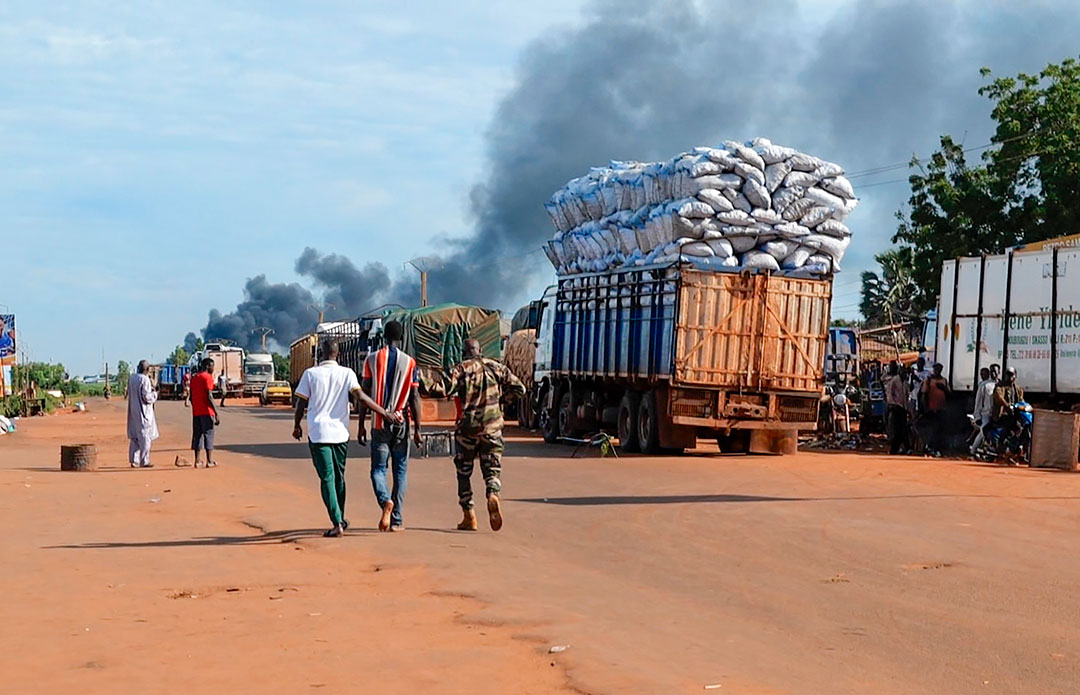
Videos of fuel tanker trucks burning on Malian roads began appearing on social media in September 2025, signaling the beginning of coordinated attacks by militants trying to blockade the capital, Bamako.
Jama’at Nusrat al-Islam wal-Muslimin (JNIM), an umbrella group of terrorists affiliated with al-Qaida, had entered a new phase of economic warfare in its quest to destroy Mali’s ruling junta.
On October 28, 2025, JNIM fighters ambushed dozens of tankers on roads leading to Bamako. In the city of Kati, the junta’s primary stronghold just outside the capital, a key Army garrison was unable to respond due to a lack of fuel.
Counterterrorism experts say JNIM’s strategy of encircling and choking off Bamako is working. They warn that toppling Mali’s fragile military government could turn the country into a failed state, in which terrorists would be free to operate, plan more ambitious attacks, and establish training camps, cyberterrorism hubs and propaganda units.
“If [JNIM] were to capture the state apparatus in Mali, the country could easily become a haven for jihadists in the region and become a leading state sponsor of terrorism on the continent, much like Sudan became after Islamists came to power following a 1989 coup,” analysts Haleigh Bartos and John Joseph Chin wrote in a November 25 blog post for the Atlantic Council.
“If left unchecked, JNIM could grow bolder, bigger, acquire additional affiliates, and, one day, sponsor or enable operations beyond the region.”
JNIM has advanced into the center of the country and has established itself in large swaths of neighboring Burkina Faso and Niger. More recently, it has expanded operations in western Mali and advanced south of Bamako for the first time, positioning itself to enforce the fuel blockade by attacking convoys from coastal countries such as Côte d’Ivoire and Senegal.
Although the junta tries to project strength and support in Bamako with rallies and media suppression, the countryside continues to slip beyond its reach. JNIM and the Islamic State group’s affiliate in the Sahel enjoy relatively free rein throughout vast lands with lucrative gold reserves and smuggling routes.
Today, more than 70% of Mali is either controlled or contested by terrorist groups. Nearly 2 million Malians are displaced, farming has collapsed, secular schools have been shuttered outside urban areas, and girls’ education has stopped completely in much of the country. A senior employee of a humanitarian group in Bamako warned that the country is undergoing a “slow-motion Talibanization.”
With the capital and junta leaders in their crosshairs, JNIM’s goal is to trigger another coup, according to several security analysts and diplomats.
“I don’t think the regime is strong enough to hold onto power indefinitely,” a security analyst who was not authorized to speak to the media told Reuters for a November 2025 article. “There are too many forces, both from a political angle but also from the armed groups’ angle, that are trying to put pressure.”
Justyna Gudzowska, executive director at investigative research group The Sentry, said the blockade is designed to strike at the legitimacy of Mali’s military rulers.
“The fuel blockade is more than an act of economic warfare, it is also a terrorist tactic,” she told Reuters. “It instills fear among Bamako’s ruling elite and the general population, creating the perception that the capital is under siege and that JNIM is closing in.”
The analysts believe that state capture in Mali would trigger a domino effect in neighboring Burkina Faso and Niger, where military juntas similarly took power in coups. In 2023, the three countries formed a military and economic bloc called the Alliance of Sahel States.
“No scenario at this point can be excluded,” a senior diplomat in Bamako told Reuters. “We cannot rule out the possibility that JNIM might try to enter the city.
“If Mali collapses, everything collapses. If the current balance of power collapses, the Alliance of Sahel States collapses.”