

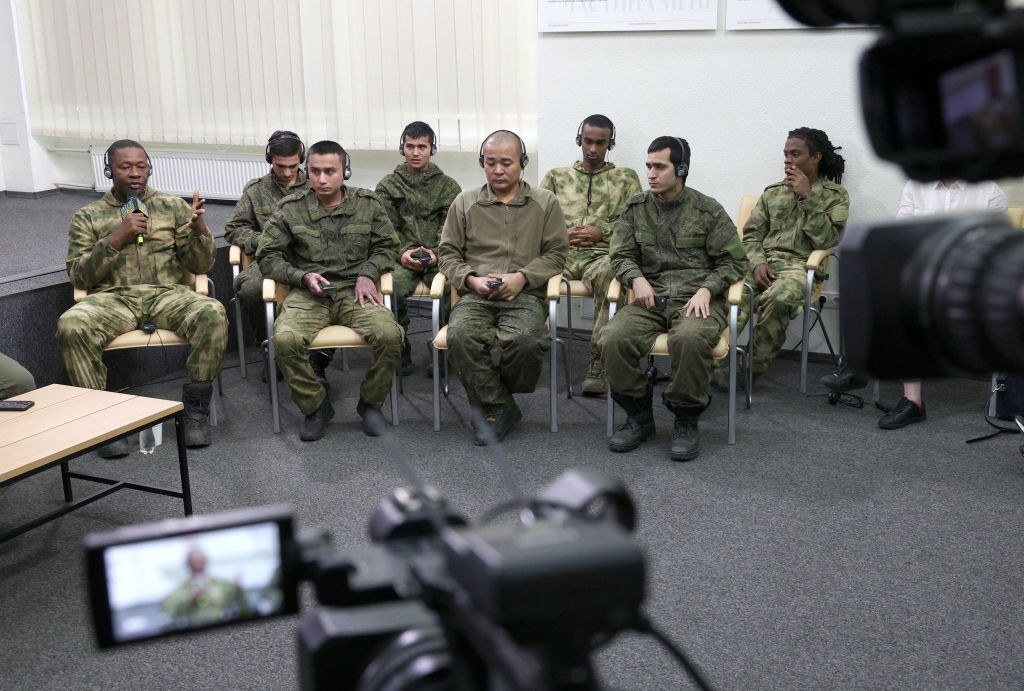
Botswana recently joined a growing list of African countries whose citizens have been tricked into fighting for Russia in its war on Ukraine.
The Ministry of International Relations said on December 15 that it has launched an investigation into reports of two young men who were taken to Ukraine to fight for the Russian Army. Batswana authorities are working through diplomatic channels to find the men and bring them home.
“The ministry wishes to inform the public that it has received reports concerning two male Batswana youth, aged 19 and 20 years, who allegedly fell victim and succumbed to a deceptive recruitment process that resulted in them fighting on the frontlines of the ongoing Russia-Ukraine armed conflict,” the ministry said, adding that the men were “led to believe they would participate in a short-term military school training program in Russia.”
Russia has systematically recruited foreign nationals, particularly from Africa, since launching its invasion in 2022. It has employed schemes, often disguised as training or employment opportunities, to draw men and women to the frontlines and into support roles such as manufacturing drones.
In November, Kenya said that more than 200 of its citizens were fighting for Russia in the war against Ukraine. South African authorities have reported that 17 citizens currently are trapped in Russia after being recruited under similar circumstances, while others were arrested before reaching Moscow. In early December, police detained five people on suspicion of recruiting South Africans for Russia.
Thierry Vircoulon, a researcher with the French Institute of International Relations, co-authored a study on Russia’s recruiting approach in sub-Saharan Africa.
“These abusive and deceptive recruitment practices are akin to a form of human trafficking, the most tragic consequence of which is the sending of amateur mercenaries to the front lines as ‘cannon fodder,’” he said in a December 18 news release. “For some, this migratory adventure in a foreign war is a one-way trip, and for many, the war is a trap that closes in on them.
“African governments are now beginning to react against this abusive recruitment policy. Investigations have been launched in several countries, and the Kenyan and South African governments have demanded that Moscow repatriate their citizens serving in the Russian army. Other African governments will certainly follow suit, further exposing Russia’s recruitment practices.”
Botswana cautioned its citizens against falling victim to “dubious, life‑threatening international recruitment schemes” that promise money for combat.
“The youth are encouraged to remain vigilant and to engage relevant authorities, including Botswana Diplomatic Missions, to verify the authenticity of questionable recruitment proposals,” it said.
Ukraine’s Ministry of Foreign Affairs lauded Botswana for warning its citizens of the dangers of Russian recruitment schemes.
“This recruitment process, which requires the conclusion of formal contracts and direct interaction with Russia’s Ministry of Defense or the General Staff, clearly demonstrates the involvement of Russian state institutions,” it said in a December 16 statement.
These practices “cannot be characterized as isolated criminal acts or the work of unauthorized intermediaries. They constitute an organized and systematic policy implemented by the Russian state apparatus as part of an aggressive war against Ukraine, in flagrant violation of the United Nations charter, international humanitarian law and fundamental human rights norms.”
Popular social media commentator Zack Mwekassa, a Congolese boxer who lives in South Africa, spoke out against Russia’s recruiting practices.
“These are kids,” he said in a social media video posted on December 18. “They are fighting in Ukraine. How did a 19- and 20-year-old find themselves in Ukraine fighting for Russia? I don’t understand that. … Botswana is one of the most peaceful countries in the world, one of the most democratic countries in Africa. How did two kids from Botswana find themselves in this place? It’s very sad.”