

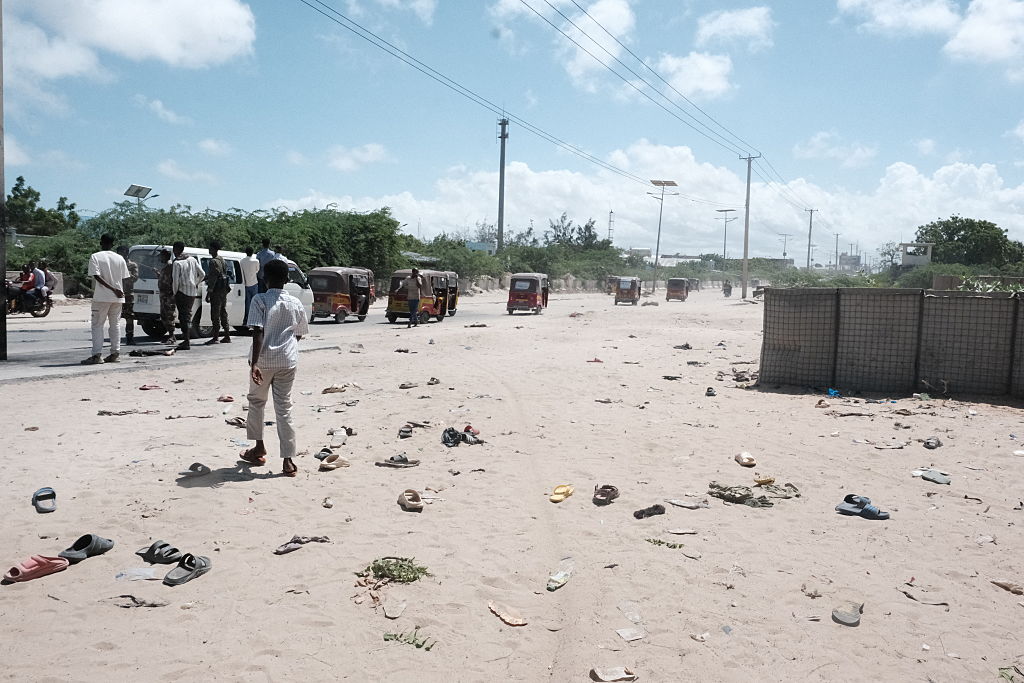
The al-Qaida-linked terror group al-Shabaab has surrounded Mogadishu and threatens to seize Somalia’s national capital with ongoing, brazen attacks in and around the city, according to a recent report.
In early October, the group used a car disguised as a military vehicle to bomb a branch of the Somali National Intelligence and Security Agency (NISA), destroying valuable intelligence and releasing dozens of prisoners. The attack occurred near the presidential palace. A July attack targeted a military base in Mogadishu. Al-Shabaab checkpoints now surround Mogadishu’s outskirts, and the group controls about 30% of Somalia’s territory.
Mogadishu is now “essentially a metropolis with a diplomatic corps and a demoralized, ineffectual army,” analyst Matt Bryden wrote for the Africa Center for Strategic Studies. In November, Somali Chief of Defense Forces, Gen. Odowaa Yusuf Raage, told Parliament that between 10,000 and 15,000 troops were killed or wounded in action during the past three years. Many of the troops were killed in battles with al-Shabaab and the Islamic State group in Somalia.
“Absent a dramatic change in direction, likely near-term scenarios include collapse of the federal government and an al Shabaab takeover of the national capital, with profound consequences for regional stability and security,” wrote Bryden, a founding partner of Sahan, a policy and research center focused on Horn of Africa security topics.
The shortcomings of Somalia’s security forces have left the federal government reliant on the African Union Support and Stabilization Mission in Somalia. However, Mogadishu’s political interference has left the mission “under strength, without a unified chain of command, and hemorrhaging donor support, threatening the reduction or termination of the mission,” Bryden wrote.
Some observers believe President Hassan Sheikh Mohamud’s attempts to amend the constitution, impose a new electoral system and redraw the federal map are signs he wants to retain power past the end of his term in May 2026. According to Bryden, this has left Somalia’s political class polarized and unable to forge a united front against al-Shabaab.
“Al Shabaab’s seizure of Mogadishu may already be simply a matter of time — whether through military action or negotiations,” Bryden wrote. “If so, a new cycle of armed conflict between a further empowered al Shabaab in control of Mogadishu and its 4 million inhabitants, and their sworn enemies in other parts of the country will be all but inevitable. Neighboring countries would similarly face the heightened prospect of renewed terrorist attacks across their borders. The time for hopeful half-measures is past. Only urgent, decisive, and concerted intervention can prevent Somalia from becoming a jihadist state.”
Mogadishu resident Samatar Talliye told Fox News Digital that danger mostly lies in places where the government is absent.
There are “pockets in Jubaland, South West State, Hirshabbele and Galmadug,” Talliye said. “The state governments are weak and mostly only control a couple of the big towns, unlike Puntland and Somaliland that control the majority of their state.”
Somali security forces have had some recent successes against al-Shabaab. On December 10, NISA killed at least 12 al-Shabaab militants in the Afgooye district 29 kilometers from Mogadishu. A senior al-Shabaab leader was among the dead. The raid targeted hideouts and locations where the terrorists were preparing explosives. However, civilians and two NISA Soldiers were killed when al-Shabaab fired mortars into civilian areas, the agency said in a news release.
Members of Somalia’s Danab special forces brigade in mid-September captured several al-Shabaab fighters during an operation in Toratorow in the Lower Shabelle region. The Somali Defense Ministry said the militants were arrested and accused of extorting and abusing area civilians. One of them, identified as Zakariye, is the son of Macallin Cabdirahman, a prominent al-Shabaab leader.
Despite these successes, Bryden wrote that saving Somalia from “the abyss” is more of a political than military challenge.
“Al Shabaab can only be defeated through simultaneous military action on multiple fronts, with the strategic objective of dismantling their strongholds in the Juba River Valley and southwest Somalia,” Bryden wrote. “This, in turn, can only be achieved by coordinated deployment of FMS [Federal Member States] security forces, with select federal units in a supporting role. This demands a level of trust between FGS [federal government] and FMS political leaders that currently is lacking.”
Mohamud’s administration “appears to be more focused on sidelining and subordinating” the federal member states rather than enlisting their support in the fight against al-Shabaab, Bryden added.