

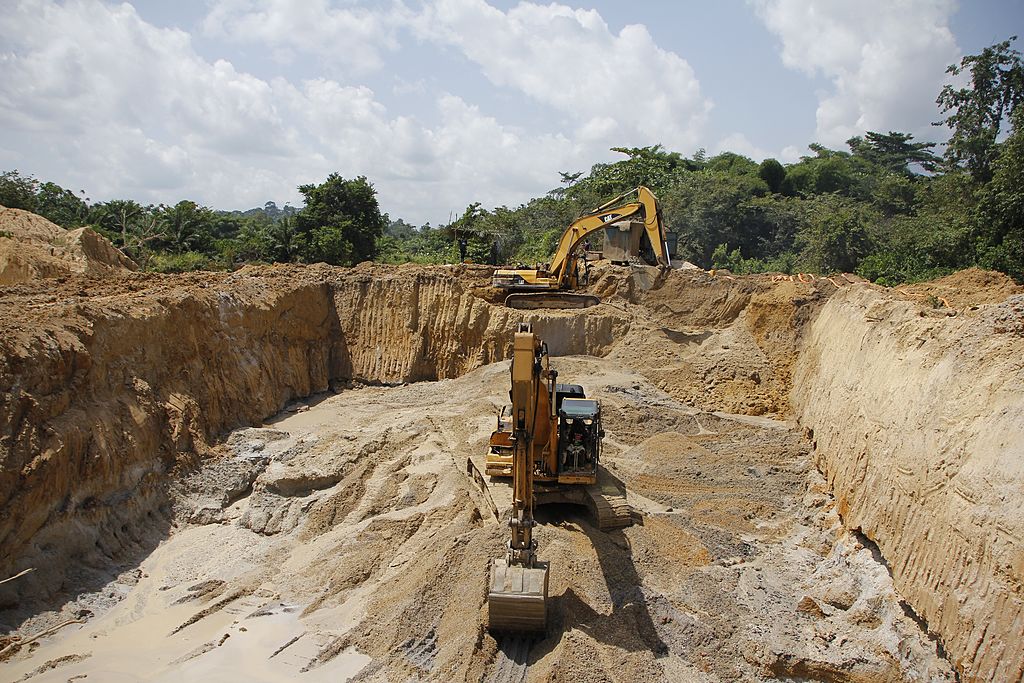
Jean Bakomito Gambu, governor of the Democratic Republic of the Congo’s northeastern Haut-Uélé province, visited a gold mining site this year after Chinese companies had laid waste to the area through illegal mining.
“As you can see, this river is practically destroyed,” Gambu said while standing by the mine. “The water can no longer flow normally, and the economic benefits of this development for the province are zero.”
Across many parts of Africa, a network of Chinese companies is engaged in illegal gold mining that devastates local communities, destroys forests and poisons water sources. Along with eastern parts of the DRC, Chinese gold mining heavily impacts West African countries, most notably Ghana, where China is involved in illegal small-scale mining known as galamsey.
“Chinese operators in illegal mining often convert farmland, forest, and rivers into mining sites — sometimes forcibly or through collusion with government, traditional leaders, and private landowners — eroding long-standing livelihoods rooted in agriculture and fishing,” researchers led by Abosede Omowumi Babatunde from Nigeria’s University of Ilorin recently wrote for the Atlantic Council.
“The loss of land for farming bananas, rice, potatoes, and other traditional crops undermines food security, fuels social tension, and stokes conflicts between local communities and Chinese miners,” the researchers added.
Surging gold prices are driving the growth of mines across the continent. However, illegal gold mining has become an issue largely due to lax enforcement, corruption among government regulators and the involvement of transnational criminal organizations, according to researchers.
While large, formal mines exist across Africa, the biggest problems come from small-scale operations where the lines blur between artisanal mining by individuals and so-called “semi-industrial” mining by Chinese companies using excavators, other heavy equipment and chemicals to extract gold from the landscape. In both cases, environmental regulations are often ignored.
“Deforestation and soil erosion are commonplace across West African mining sites, and pollution of marine and freshwater bodies occurs at multiple stages of mining exploration,” the Atlantic Council reported. “Small-scale gold mining causes extensive land degradation and harms water quality.”
China’s semi-industrial mines are driving out artisanal miners from sites where they pan for gold. Artisanal gold mining is deeply rooted in the local communities and plays a crucial role in local economies, according to a report by the Dutch peace advocacy group PAX.
In a recent report by PAX, satellite images of the eastern DRC community of Moku show 77 kilometers of destroyed or damaged rivers and streams caused by semi-industrial gold mining. That damage is part of a broader pattern that has left more than 250 kilometers of rivers and creeks across Haut-Uélé province damaged between September 2020 and September 2024.
Starting in August 2024, Gambu required all foreign operators or cooperatives in Haut-Uélé’s semi-industrial gold mining sector to register with the provincial government. Shortly after visiting the mining site at Watsa in January, Gambu shut down the operation.
Like other illegal Chinese mines, the Watsa operation is run by Chinese workers operating under the guise of a Congolese-owned cooperative, Gambu said.
“The Congolese apply for exploitation in terms of cooperatives, they receive authorizations, but in the end, it is foreigners who operate through the cooperatives,” he said.
To combat illegal mining, the Atlantic Council researchers recommended that local communities work with government agencies and not-for-profits to monitor mining and identify the illegal operators.
“These groups would expose collusion between Chinese entities, local actors, and transnational criminal networks,” the researchers wrote.