
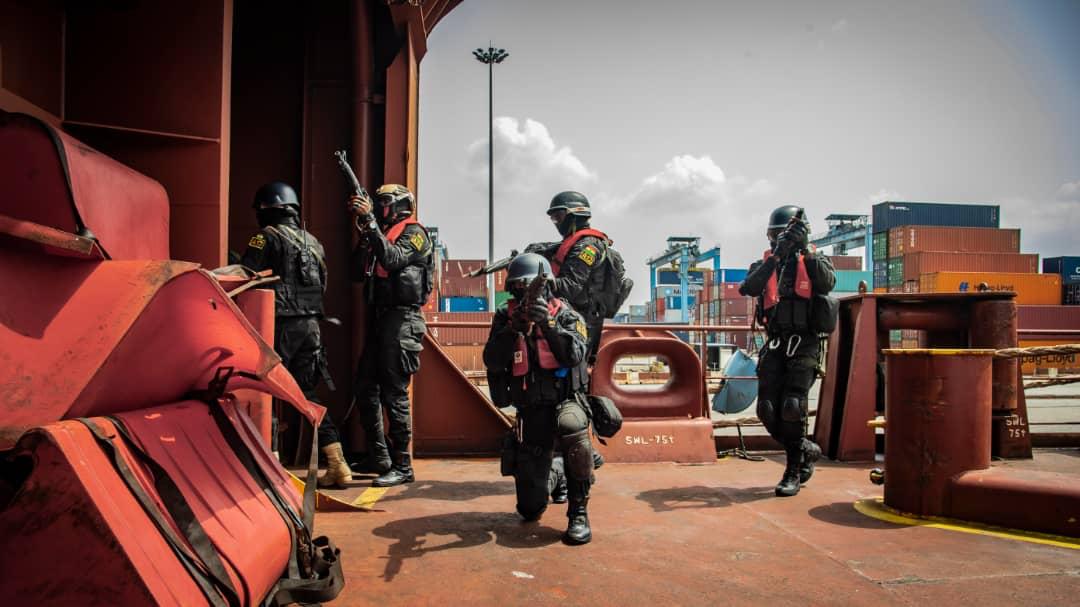
As Sahelian insecurity continues its westward and southward surge, Ghana is beefing up its maritime security to address sea crimes such as illegal, unreported and unregulated fishing, piracy, and illicit weapons trafficking. Many illegal weapons pass through Ghana on their way to the Sahel.
Writing for The Africa Report magazine, analyst Kent Mensah noted that Ghana’s increasing collaboration with the European Union, Germany and France, which has completely withdrawn from the Sahel to focus more on coastal states, has positioned Accra as a “new stabilizing force in the region.”
In September 2025, the Tonnerre, a French amphibious warship, entered the port in Tema, Ghana, to participate in Siren, a regional joint navy training exercise that focused on anti-piracy, pollution control and crisis-response drills. The Tonnerre also participated in the weeklong Grand African Nemo maritime security exercise that involved 20 African nations. The exercise, held in Accra, Ghana’s capital, ended November 17.
“I am proud to reaffirm Ghana’s commitment to regional maritime security and sustainable fisheries management,” Emelia Arthur, Ghana’s fisheries minister, told The Africa Report. “Illegal fishing, piracy and trafficking threaten the livelihoods of our people.”
In December 2024, Accra commissioned its largest forward operating base at Ezinlibo, on the Gulf of Guinea, near the border with Côte d’Ivoire. More bases are planned for the coastal towns of Ada, Elmina, Keta and Winneba. According to Rear Adm. Godwin Livingston Bessing, Ghana’s chief of naval staff, the country is preparing for a more assertive maritime posture.
“We are in the process of acquiring offshore patrol vessels to enhance our operational capabilities,” Bessing told The Africa Report. “This ensures we are better prepared to secure our maritime territory and counter both traditional and emerging threats.”
Ghana also is expected to establish a new Maritime Fusion Center to strengthen its capacity to respond to sea crimes, including attacks on underwater cables that serve as the country’s digital lifeline.
In 2025, Ghana adopted a new law aimed at stemming illegal fishing. Among other new regulations, the Ghanaian government expanded the country’s inshore exclusion zone (IEZ) from 6 to 12 nautical miles from shore. Foreign trawlers from China and other areas commonly breach Ghana’s IEZ to catch fish meant for the country’s artisanal fishermen. Illegal fishing costs the nation an estimated $14.4 million to $23.7 million annually.
Although piracy in the Gulf of Guinea has declined, it still threatens Ghana, other coastal nations and the shipping industry. In 2023, 26.5 million tons of cargo passed through Ghanaian ports, which serve as a strategic trade corridor for landlocked neighboring countries such as Burkina Faso, Mali and Niger.
In early December, pirates attacked a carrier containing liquefied petroleum gas in the Gulf of Guinea, near Equatorial Guinea, and kidnapped nine crew members. At the time, the Neptune P2P Group, an international private security company, reported that there were at least 17 armed robberies or piracy incidents in the Gulf of Guinea during the past year.
Even when piracy originates far from Ghana’s waters, “we still feel the impact — from threats to offshore energy infrastructure to disruptions in maritime communication cables,” Kamal-Deen Ali, director-general of the Ghana Maritime Authority, told The Africa Report.
Vice Adm. Issah Yakubu, executive chairman of the Gulf of Guinea Maritime Institute, said that although regional coordination and information sharing has advanced in the past decade, the region remains a target for sea crimes, as many foreign allies have withdrawn warships from the region due to Russia’s war in Ukraine.
“That exposed the limits of relying on foreign naval presence,” Yakubu told The Africa Report. “Our governments must invest more. Ghana has deployed armed guards on fishing vessels, but more needs to be done to strengthen joint operations across the region.”