
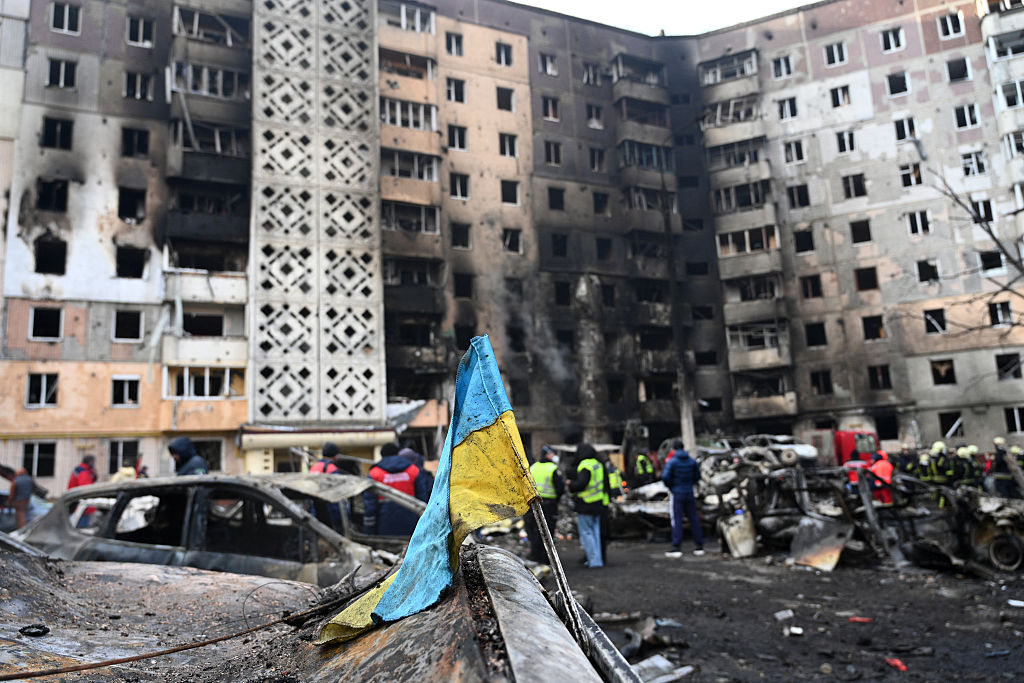
Several South African men were shown milling around a parking lot wearing military uniforms bearing Russian flag badges. Behind them, a man said they were “off to fight Zelensky,” referring to the Ukrainian president.
Speaking anonymously, one of the men said they were lured to Russia for training to provide “VIP protection” for more than 40,000 rand per month (more than $2,323), South Africa’s SABC News channel reported. They instead were transported to Ukraine’s embattled Donbas region, the majority of which Russia controls, to fight in the Kremlin’s drawn-out war. None of them had previous military training.
Some of the 19 men flew from Durban to Dubai to Russia in July. In early November, a group of 17 of the mercenaries, aged 20 to 39, sent distress calls for assistance to return home, South African President Cyril Ramaphosa said. Two of the mercenaries are believed to have died.
“How long will it take? Because our situation is dire here,” the anonymous fighter told SABC News in a November 24 report. “It must happen in the next two or three days. These people here are saying they are tired of us and in the next four or five days they are moving us to the frontlines in the war. They are saying, ‘Your people back home don’t want to take you back to your country.’”
Mlungsie Mncube, a brother of one of the recruits, said the men were told they would receive special training in Kenya. Recruiters offered a lump sum of 80,000 rand (more than $4,646) and promised nearly 1 million rand (almost $58,100) upon their return home after one year.
“They didn’t know they were going to war,” Mncube told SABC News. “They believed they were going for training and would come back to be part of MK [uMkhonto weSizwe] security forces. Those who recruited them, we don’t know what their intention was, but we know they were given money.”
Mncube said the families have met one another but need help bringing the men home. He said he feared they will never return. According to Ramaphosa, 16 of the men are from KwaZulu-Natal and one from Eastern Cape. South Africa is “working through diplomatic channels to secure the return of these young men,” Ramaphosa said, adding that he and the government “strongly condemn the exploitation of young vulnerable people by individuals working with foreign military entities.”
South African law prohibits citizens from providing military assistance to other governments or joining foreign armed forces without official authorization.
“We hope that the situation with Russia violating South African legislation and dragging or luring these people into this war will … be an eye-opener for South African society,” Oleksandr Shcherba, Ukrainian ambassador to South Africa, said in a report by Agence France-Presse (AFP). “Ever since this news broke, I received emails from family members of these young people who were lured to the front line. And they were desperate. Don’t do that to your mothers and fathers and sisters.”
Russia has intensified recruitment in Africa and the Middle East as it sustains heavy losses and manpower shortages. Frontelligence Insight, an open-source intelligence group, reported that Russian recruiters often target economically vulnerable countries, offering large sums and promising bogus noncombat roles.
“My message to South African citizens right now is, please don’t get fooled and don’t get involved to fight in this barbaric, unfair, unjust war,” Shcherba told AFP. “This is not your war, it’s … not the war of any decent person on this planet.”
The stranded men were “fooled to fight in a war … that Africa has nothing to do with, and it’s a colonial war, so seeing Africans fighting a colonial war against a free country is especially insane,” he added.
On November 28, Duduzile Zuma-Sambudla, daughter of former South African President Jacob Zuma, resigned from parliament after being accused of tricking the men into joining a Russian mercenary group to fight in Ukraine. Zuma-Sambudla’s half sister, Nkosazana Bonganini Zuma-Mncube, had filed an affidavit accusing her of luring the men to Russia on claims that they would receive yearlong security training and then return to South Africa. At least eight of the 17 men were members of the Zuma family, the affidavit said.
Zuma-Sambudla joined parliament in 2024 under her father’s opposition uMkhonto weSizwe (MK) party. One South African man fighting in Ukraine told The New York Times he received a phone call in July from someone who identified themself as Zuma-Sambudla to join a yearlong training program in Russia after which he would have a job working in security for the MK party. Six weeks after arriving in Russia, he was given military fatigues and sent to the front lines of the war in the Donbas region.
Another South African man fighting in Ukraine told the BBC that Zuma-Sambudla and other recruiters bought him tickets to travel from South Africa. South African police are investigating.